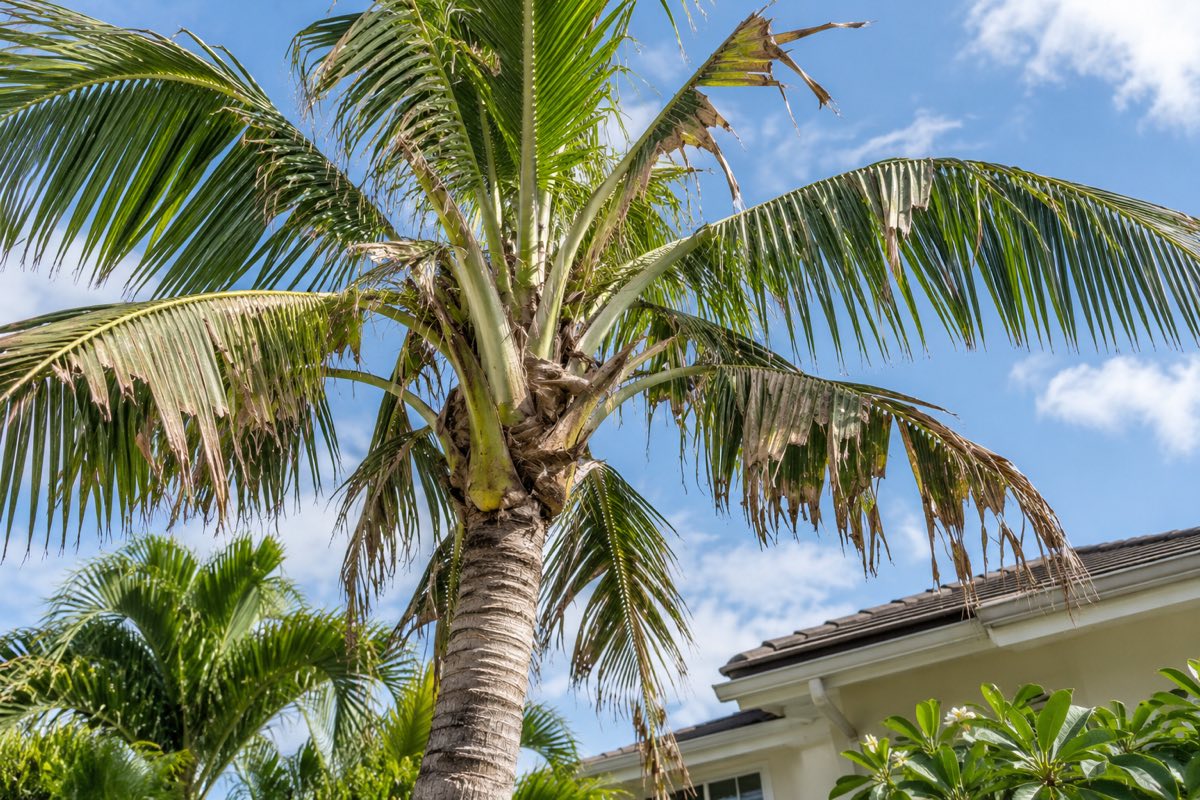
A coconut palm with torn fronds and visible beetle damage may look beyond saving. But damaged leaves do not always mean the entire palm is dying.
For property owners on Oahu, the important question is whether the palm can continue producing healthy growth or whether coconut rhinoceros beetle (CRB) activity has caused more serious damage.
A palm can sometimes survive CRB feeding damage, but recovery depends heavily on whether its growing point remains functional. If that growing point is destroyed, the palm cannot replace it and eventually dies.
At Pacific Island Landscape, we provide CRB evaluation and treatment for residential estates and commercial properties across Oahu. Understanding the difference between visible leaf damage and serious crown injury helps property owners make informed decisions about continued care or removal.
Why Some CRB-Damaged Palms Survive While Others Die
To understand whether a palm can recover, it helps to know how a palm grows.
Unlike many branching trees, most palms have a single growing point at the top of the trunk. This tissue produces the leaves that form the crown.
Adult coconut rhinoceros beetles bore into the crown to feed, sometimes damaging developing leaves before they emerge.
When those leaves eventually unfold, they may display the familiar V-shaped cuts or missing sections associated with CRB.
However, the appearance of damaged leaves does not necessarily mean the growing point has been destroyed.
When the Growing Point Is Still Functional
A palm may continue growing if beetle feeding has damaged developing leaves without destroying the growing point.
Previously damaged fronds will not repair themselves. Instead, the palm must produce new leaves.
This distinction is important because even a palm that remains alive can look unattractive for some time while older damaged foliage remains visible.
When the Growing Point Is Destroyed
Damage becomes much more serious when CRB feeding reaches the growing point.
The Hawaii Department of Agriculture and Biosecurity explains that destruction of this tissue can cause palm death. Beetle feeding wounds may also expose palms to secondary infections.
Because most palms cannot produce a replacement growing point after the original is destroyed, recovery is not possible once that critical tissue is lost.
For property owners, this means the condition of the growing point matters more than the number of visibly damaged leaves alone.
What Healthy New Growth Can Tell You
One of the most useful distinctions when evaluating a damaged palm is the difference between older fronds and emerging growth.
CRB damage often becomes visible after the beetle has already fed inside the crown.
According to CRB Hawaii's explanation of palm damage, the location of damage within the crown can help indicate when feeding occurred.
For example, a palm might have heavily damaged older leaves while newer leaves show fewer obvious defects.
That pattern can be encouraging because it suggests the palm has continued producing foliage. However, it does not establish that CRB activity has stopped or that the palm is fully healthy.
Property owners should consider several observations together.
| What you notice | What it may mean |
|---|---|
| Older fronds are damaged, but newer growth continues | The palm is still producing leaves |
| New leaves repeatedly emerge with damage | Further investigation of CRB activity is warranted |
| Central growth appears abnormal or deteriorated | The growing point may be compromised |
| The entire crown is deteriorating | Serious plant-health problems may be present |
| Previously damaged leaves remain unchanged | Expected, because damaged tissue does not regenerate |
None of these observations alone provides a complete diagnosis.
If the palm is tall or difficult to inspect from the ground, avoid climbing or attempting to open the crown yourself. A professional assessment is more appropriate.
How Long Does a CRB-Damaged Palm Take to Recover?
There is no reliable recovery timeline that applies to every palm.
The amount of visible improvement depends on the palm's species, growing conditions, existing health, and severity of injury.
Even when a palm survives, damaged fronds may remain visible until they age and are replaced by subsequent growth.
Recovery is therefore not necessarily a matter of waiting a few weeks for existing leaves to look normal again.
Why Recovery Can Appear Slow
Palm crowns contain leaves at different stages of development.
A frond emerging today may have been injured while it was still enclosed inside the crown. Consequently, damaged growth can become visible after the original feeding event.
This delayed appearance can make it difficult to determine whether recent-looking leaf damage reflects ongoing beetle activity.
It also explains why evaluating a palm solely from one photograph may be misleading.
New growth patterns, the condition of the crown, and other site factors all matter.
Property owners should avoid interpreting every newly visible cut as proof that a previous treatment failed.
Can CRB Treatment Save an Already Damaged Palm?
Treatment may help protect a palm against further feeding, but it cannot repair tissue that has already been destroyed.
That difference is central to deciding whether continued treatment makes sense.
If the palm's growing point remains functional, reducing future beetle injury may improve its prospects. However, other plant-health problems and continued pest exposure can still affect the outcome.
If the growing point has been irreversibly destroyed, pesticide treatment cannot recreate it.
Our residential CRB evaluation and treatment service considers the palm's condition before a treatment method is proposed.
Depending on site conditions and the selected product label, injection or soil drenching may be considered.
Neither method guarantees that a damaged palm will survive. We define the selected work in a written proposal rather than promising a specific recovery outcome.
When Is Palm Removal the More Appropriate Option?
Removing a damaged palm should not be an automatic response to every CRB symptom.
A palm with surviving growing tissue may still have a reasonable opportunity to continue growing.
However, there are situations where removal deserves serious consideration.
These include substantial crown deterioration, suspected loss of the growing point, or a declining palm that presents a potential hazard.
Consider the Palm's Location
The consequences of palm decline also depend on where the tree stands.
A deteriorating palm beside an entrance, pedestrian route, driveway, or commonly occupied outdoor area raises different concerns from one in a restricted landscape area.
For commercial properties, access and public use may influence how quickly further assessment is needed.
Suspected structural instability or falling-frond hazards warrant appropriate professional evaluation. A general CRB inspection does not substitute for a qualified tree-risk assessment.
Consider Whether the Palm Can Continue Growing
A severely damaged crown may warrant evaluation of whether the growing point is still functioning. This should not be determined from cosmetic appearance alone.
The presence of brown or torn leaves does not automatically justify removal, just as a remaining green frond does not establish that a palm will survive. The decision should reflect the actual condition of the tree.
Consider the Work Required After Removal
Removing a palm is not always the end of the project.
Stump work and the handling of potentially infested material may require separate planning.
Our tree removal and canopy management services can address qualifying tree concerns, with removal and related work defined in the approved scope.
CRB treatment does not automatically include palm removal, stump grinding, or debris hauling.
Treatment or Removal: How to Compare Your Options
For a property owner deciding what to do next, the following comparison can help organize the discussion.
| Consideration | Continued care or treatment | Removal |
|---|---|---|
| Growing point | May be appropriate if still functional | More relevant if irreversibly destroyed |
| Visible frond damage | Existing damage remains until foliage is replaced | Removes the affected palm |
| Future CRB exposure | Remains possible | Other palms on the property may still be exposed |
| Property access | Treatment access must be evaluated | Equipment access and work-area constraints may matter |
| Additional work | Further visits only if approved | Stump handling and debris disposal may require separate scopes |
| Main uncertainty | Whether the palm will continue growing | Removal requirements and any replacement plan |
A treatment-versus-removal decision should not be based solely on the initial price.
The condition of the palm, its location, and the work actually required are more meaningful starting points.
What If You Decide to Replace the Palm?
If a severely damaged palm must be removed, the next question is what should take its place.
Replacement does not necessarily mean installing the same species in the same location.
Depending on the landscape, a property owner may consider another palm species, a different type of tree, or an alternative planting arrangement.
Important considerations include the planting area's available space, soil conditions, exposure, irrigation, and the long-term size of the selected plant.
CRB susceptibility also matters when evaluating possible palm replacements.
We provide landscape design and installation services and operate a private nursery in Kapolei. Where a replacement landscape is being considered, we can review suitable material options as part of a separately approved project.
Our Kapolei nursery supplies large-format landscape material when available, but individual plant species and sizes must be confirmed for each project.
Replacing a palm should solve a real landscape need rather than simply reproduce the previous planting without considering why it may no longer be appropriate.
What to Do if Your Palm Is Showing Serious Decline
If your palm already has extensive CRB-related damage, the next step is to establish what is happening to the tree rather than immediately choosing a pesticide or arranging removal.
Photographs showing changes over time can help document the problem. Pay particular attention to the condition of newly emerging growth and any deterioration in the central crown.
We recommend seeking professional evaluation when the palm's condition is uncertain, particularly if it is located near areas used by people or vehicles.
Our team can review suspected CRB activity and define the landscape services being requested. Where specialist diagnosis or a qualified tree-risk assessment is necessary, that work must be separately arranged unless expressly included.
Make an Informed Decision About Your Damaged Palm
A CRB-damaged palm is not automatically a lost tree.
Some palms continue producing new growth after beetle feeding. Others suffer damage that compromises their ability to survive.
The critical distinction is whether the growing point remains functional and whether the palm's overall condition supports continued care.
At Pacific Island Landscape, we help Oahu property owners evaluate suspected CRB activity and consider appropriate treatment or separately scoped removal work.
If your palm has significant crown damage and you are unsure whether to preserve or remove it, contact us to request a property review.
Call 808-347-4462 to discuss the affected palm and the next step for your property.
Pacific Island Landscape | Hawaii Contractor License CT-35972