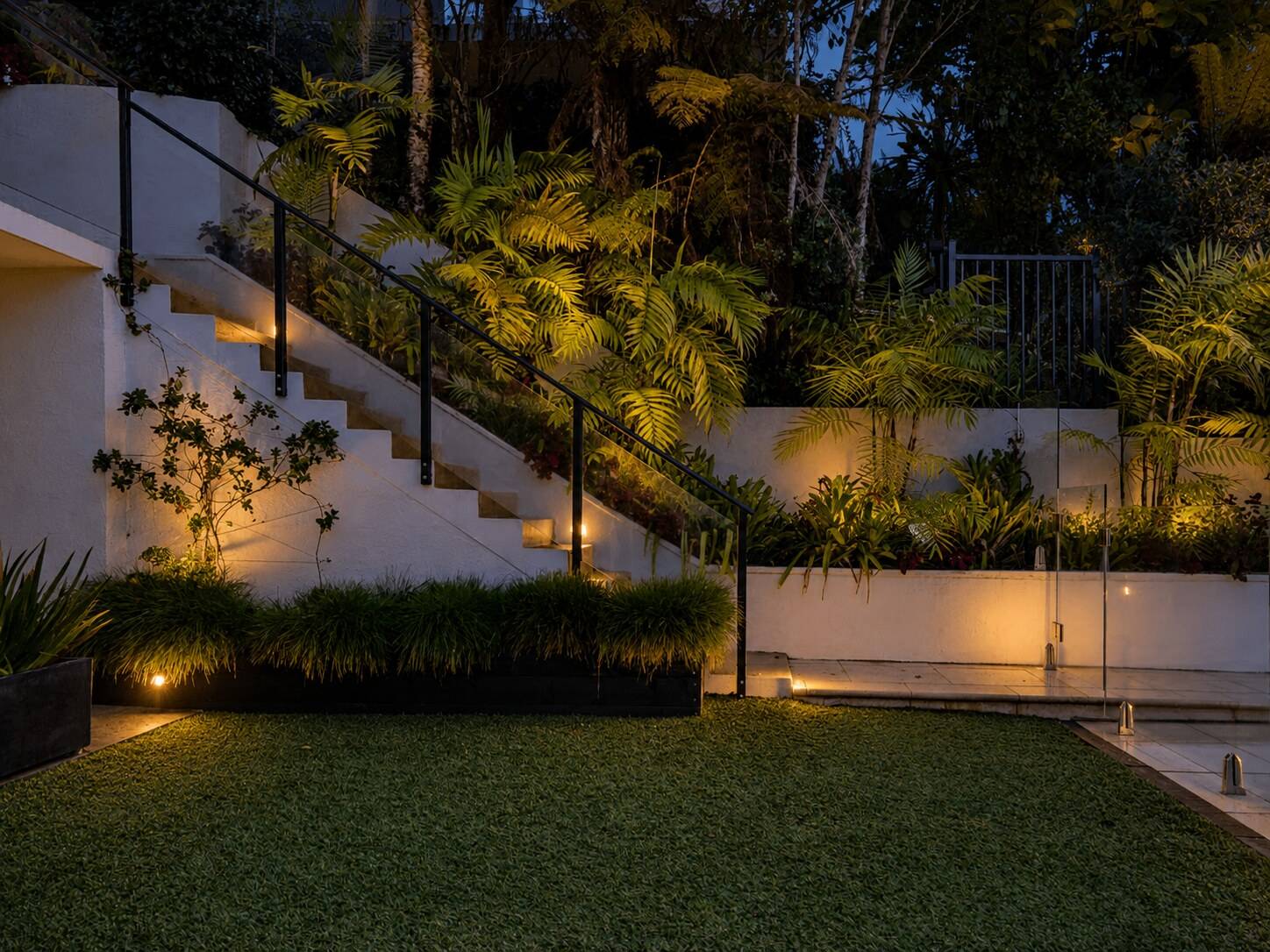
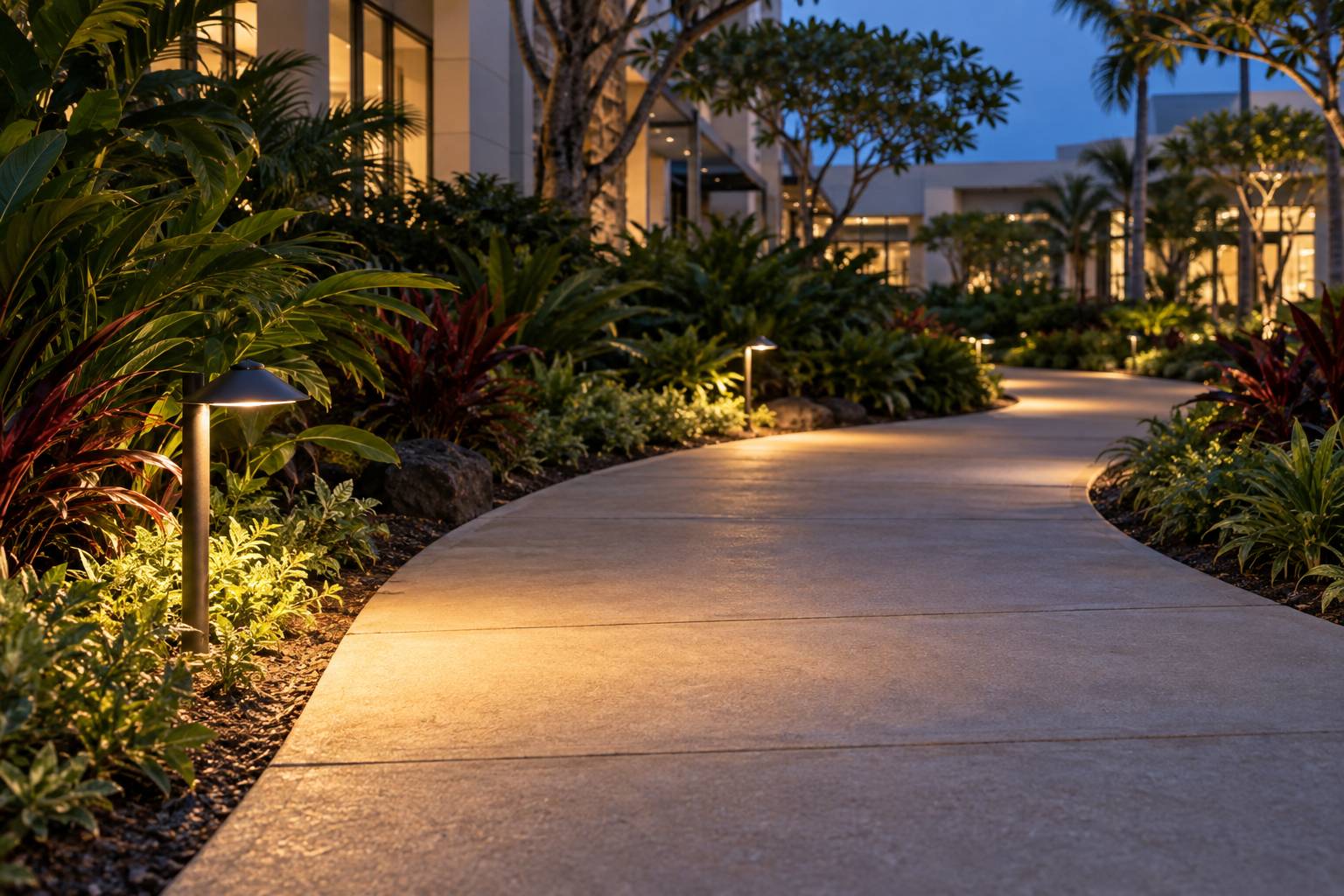


Begin With the Commercial Lighting Objective

A lighting plan should identify what each illuminated area is expected to accomplish. General instructions to light the property do not provide enough direction for fixture selection or placement.

Lighting objective Planning focus
Entry visibility Agreed coverage near the approach and landscape surrounding the entrance
Pedestrian routes Fixture position and the portion of the route included in the layout
Changes in elevation Visibility near steps or transitions within the landscape area
Planting accents Direction and coverage around selected plant material
Property presentation Lighting of approved landscape features viewed after dark
Security-related visibility Defined illumination without treating landscape lighting as a security guarantee

The proposal should connect each area to an objective. A selected feature should not be interpreted as authorization to illuminate the entire property.

What We Review Before Planning the Layout

Existing conditions influence whether a proposed commercial lighting layout can be installed as intended.

Site consideration Why it matters
Existing low voltage system Helps determine whether the request involves a new layout or modifications
Available equipment information Supports review of known capacity and component compatibility
Proposed cable route Identifies planting areas or hardscape crossings that may affect installation
Irrigation components Helps reduce conflicts with visible heads or known lines
Plant growth Influences fixture clearance and the potential for future obstruction
Occupied areas Identifies nearby windows or gathering areas that may be affected by glare
Property operations Establishes known restrictions on installation access or work timing
Site exposure Helps guide equipment review for the intended location

Visible conditions do not reveal every buried line. Additional locating or specialist review must be assigned when required. Existing equipment is not assumed to support an expansion until its available information has been evaluated.

Fixture Placement and Glare Control

More light does not necessarily create a better commercial landscape. A fixture directed toward an occupied window can create discomfort. Light extending beyond the intended feature may affect adjacent areas. Dense foliage can also block coverage as plants grow.
‍
We plan placement around the selected fixture and target. Beam characteristics depend on the approved equipment and mounting location. Field adjustments must remain within the authorized layout.
‍
Landscape maintenance can change how the lighting performs after installation. New growth may obstruct a fixture that was clear when installed. A commercial landscape maintenance agreement can state whether vegetation near lighting equipment is included in recurring care.

Existing System Capacity and Voltage Drop

Cable length and connected load can affect the voltage delivered to fixtures in a low voltage system. We therefore do not assume that an existing transformer can support additional fixtures. Known equipment information and the proposed layout must be reviewed before expansion is approved.
‍
The selected system should be evaluated against the requirements of its components. A universal fixture quantity or cable length should not be applied to every property. Those decisions depend on the actual equipment and cable route.
‍
Work involving a line-voltage circuit is not automatically included in a low voltage landscape-lighting proposal. Panel work or other regulated electrical responsibilities must be identified and assigned appropriately before the affected work proceeds.

Coordinating Lighting With Landscape Installation

Low voltage lighting often overlaps with planting beds or irrigation routes. Cable planning should account for visible irrigation components. The proposed route should also consider roots or drainage areas that may affect installation.
‍
When lighting is part of a larger commercial landscape installation, fixture locations should be coordinated before final planting. Cable routing should also be reviewed during that phase. This can reduce conflicts between the lighting layout and newly installed landscape material.
‍
Existing hardscape changes the scope. Crossing a paved area is different from routing through an accessible planting bed. Cutting or restoring hardscape is included only when the accepted proposal identifies that responsibility.

Coordinating Installation With Property Operations

Commercial lighting work may occur near tenant entries or pedestrian areas. The property team should identify access restrictions before scheduling. Required service gates or loading areas must be available during the confirmed window.
‍
Installation near an occupied area does not authorize its closure. Any required access coordination must be assigned before work begins.
‍
After-hours installation is not assumed. If the property requires work outside standard scheduling, that condition must be reviewed and included in the proposal.

Equipment Selection for the Installation Area

Fixture suitability depends on where the equipment will be installed. Areas exposed to irrigation spray require an appropriate equipment review. Coastal conditions may also influence material selection.
‍
We confirm equipment after the installation area and intended use are understood. Product availability is verified before scheduling. We do not guarantee a specific fixture service life because site exposure and maintenance conditions vary.
‍
Controls are scope-specific. A timer or another control is included only when selected in the proposal. Building-control or security-system integration is not assumed.

Related Work Confirmed Separately

Some property needs may fall outside the initial commercial low voltage lighting scope. The following items can be reviewed and documented separately when applicable.

New line-voltage circuit
Must be reviewed and assigned separately from the low voltage layout
Panel work
Electrical-panel responsibilities require separate assignment
Transformer replacement
Included only when selected equipment and responsibility are documented
Existing wiring repair
Concealed or unidentified problems require evaluation before repair is authorized
Hardscape cutting
Cutting or surface restoration must appear in the accepted proposal
Security-system integration
Landscape lighting does not automatically include alarms or surveillance equipment
Landscape restoration
Work outside the agreed installation area requires separate authorization
Ongoing lighting maintenance
Recurring inspection or adjustment requires a documented service agreement

Additional fixtures or routing changes require approval before they are added to the project.

Our Commercial Lighting Process

Project stage What we confirm
Initial discussion Areas to be illuminated and the intended lighting objective
Property review Visible conditions and known operating restrictions
Layout development Proposed fixture locations and cable-routing considerations
Scope confirmation Selected equipment and responsibilities assigned separately
Installation Approved layout and authorized field adjustments
Final review Agreed lighting areas and documented follow-up items

Equipment availability and scheduling are confirmed before installation. Changes to the layout or selected products require authorization before implementation.

Commercial Low Voltage Lighting FAQs

Where can commercial low voltage landscape lights be installed?
Can you add fixtures to an existing commercial lighting system?
Can landscape lighting improve property security?
Can lighting be included with a commercial landscape installation?
Can you work around tenant or guest schedules?
Do coastal conditions affect fixture selection?
Is ongoing lighting maintenance included?
How is commercial landscape lighting priced?
contact

Discuss Commercial Low Voltage Lighting on Oahu

Contact us to discuss the commercial landscape areas you want to illuminate and the purpose of the lighting. We will identify the property information needed to define the scope before equipment or scheduling is confirmed.

Discuss Your Commercial Lighting Project
Office
Kapolei Trade Center, 2045 Lauwiliwili Street, Suite 702, Kapolei, Hawaii 96707
License
CT-35972