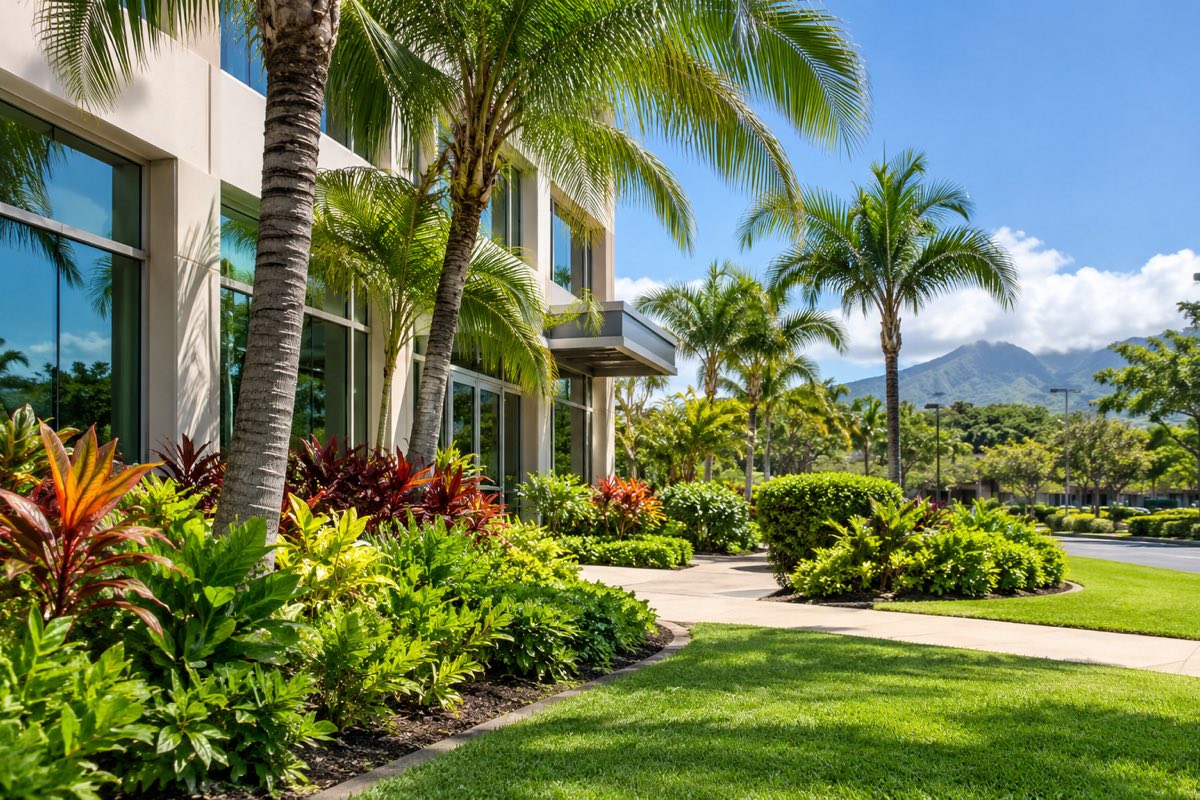
A declining palm near a hotel entrance or a row of shrubs developing brown patches can quickly become a concern for property managers. Beyond appearance, plant-health problems can affect maintenance planning, replacement costs, and the condition of areas used by tenants or visitors.
But damaged foliage does not always mean disease. Excess moisture, irrigation problems, salt exposure, and insect activity can create similar symptoms.
At Pacific Island Landscape, we provide commercial landscape disease-control services across Oahu. We begin by reviewing visible plant conditions and relevant site factors before defining a property-specific scope of work.
For property managers, the goal is to understand what is affecting the landscape, decide what action is justified, and coordinate that work with ongoing property operations.
Why Oahu's Microclimates Matter for Plant Health
Landscape disease management on Oahu requires more than following a standard treatment calendar.
Conditions vary considerably between windward communities, coastal properties, and drier leeward districts. Rainfall, humidity, wind exposure, and irrigation practices all influence how plants respond to their environment.
The Rainfall Atlas of Hawaii illustrates the differences in precipitation across the islands.
For example, a commercial property in Kapolei may experience different moisture conditions from a windward property in Waimanalo. Coastal properties can also experience salt spray, while sheltered planting areas may retain moisture longer after irrigation or rainfall.
These differences matter because several plant pathogens thrive in moist environments. Excessive irrigation can also weaken root systems or create symptoms resembling disease.
Before recommending treatment, we consider factors such as:
- Water accumulation around planting beds
- Sprinkler coverage and irrigation frequency
- Drainage and visible root-zone conditions
- Wind and coastal exposure
- The distribution of symptoms across the property
A property-specific assessment helps determine whether treatment, maintenance adjustments, or further investigation should be considered.
Recognizing Disease Versus Environmental Stress
Yellowing leaves, brown spots, and thinning canopies are warning signs, but they are not reliable diagnoses by themselves.
A shrub with declining foliage might have a fungal infection. It might also be receiving too much water or struggling with damaged roots.
The pattern of damage provides useful clues.
| Visible symptom | Possible considerations |
|---|---|
| Brown or black leaf spots | Fungal or bacterial disease, environmental injury |
| Yellowing across several plants | Irrigation conditions, nutrient availability, root stress |
| Wilting despite wet soil | Poor root function, excessive moisture, possible root disease |
| Branch dieback | Root problems, physical damage, pests, disease |
| Declining palm crown | Insect damage, bud problems, environmental stress |
| Damage concentrated in one irrigation zone | Water coverage, drainage, or localized soil conditions |
These observations help narrow the investigation, but they do not confirm a specific pathogen.
Plant Diseases That May Affect Commercial Landscapes
Different plants can experience different disease problems.
Examples relevant to tropical and subtropical landscapes include:
- Turfgrass: Certain fungi can cause discolored patches or thinning. The exact disease depends on the grass species and environmental conditions.
- Palms: Problems such as bud rot and Ganoderma-related decay may cause serious decline, although their symptoms can overlap with other conditions.
- Ornamental shrubs and trees: Leaf spots, anthracnose, and other diseases can affect foliage and appearance.
Treatment approaches differ substantially. A fungicide appropriate for one disease may have no benefit when the underlying problem is root damage or unsuitable irrigation.
When a diagnosis cannot be established through observable conditions, further specialist evaluation or laboratory testing may be needed.
The University of Hawaii CTAHR provides plant-health research and extension resources that can support further investigation.
Our commercial disease-control reviews focus on observable symptoms and site conditions. Specialist diagnosis or laboratory testing requires separate arrangements when necessary.
Coconut Rhinoceros Beetle Damage Is Not a Plant Disease
One of the important distinctions for commercial property managers is recognizing that coconut rhinoceros beetle (CRB) damage is caused by an insect, not a disease pathogen.
CRB was first detected on Oahu in December 2013. Adult beetles feed inside palm crowns, damaging developing fronds and sometimes the growing point.
Possible signs include:
- V-shaped or scalloped cuts in emerging fronds
- Bore holes near the palm crown
- Damaged or distorted new growth
- Adult beetles or larvae found around suitable habitat
These symptoms should prompt further inspection rather than an automatic diagnosis.
CRB can also breed in decomposing organic material, including mulch, compost, and deteriorating plant waste.
According to CRB Hawaii's identification guidance, identifying the beetle and potential breeding areas is important to managing an infestation.
We offer commercial CRB removal and treatment as a specialty service. Depending on the palm, site conditions, and applicable product labeling, treatment may involve injection or soil drenching.
Palm removal, stump work, and the handling of suspected breeding material require specific approval and documentation.
Importantly, no single treatment can guarantee the elimination of CRB or the recovery of a damaged palm.
For current handling and reporting requirements, consult CRB Hawaii's official guidance.
What Commercial Landscape Disease Control Should Include
Effective disease management begins with determining which plants are affected and what conditions may be contributing to their decline.
We structure our commercial plant-health services around a property-specific review and an approved scope of work.
1. Review the Affected Landscape
The initial review considers visible symptoms, affected planting areas, irrigation conditions, drainage, and relevant maintenance history.
Property managers can help by sharing when the symptoms first appeared, which areas are affected, and whether recent work or irrigation changes occurred.
2. Identify Potential Contributing Conditions
Where symptoms may involve excessive moisture or another landscape condition, the next step may be correcting that issue rather than immediately applying a product.
For example, water collecting around a planting bed may justify reviewing drainage and irrigation coverage.
Any irrigation repair or landscape modification must be included in an approved service scope.
3. Determine Whether Treatment Is Appropriate
When treatment is supported by the available findings, the proposal identifies the affected plants, intended method, and relevant site requirements.
A pesticide application should never be selected solely because a plant has discolored leaves.
Product selection and application must follow the labeling for the intended use. The label governs relevant dosage, precautions, and access restrictions.
4. Address Affected Landscape Material
Some situations require pruning, plant removal, or management of affected debris.
These services should be clearly identified rather than assumed to be part of every disease-control visit.
Our commercial debris and waste removal services can be scoped for approved landscape material.
Suspected CRB-infested material requires special attention. It should not be transported as ordinary green waste without reviewing current treatment and handling guidance.
5. Document Follow-Up Requirements
Not every plant-health problem can be resolved through one visit.
When monitoring or repeat treatment is appropriate, the frequency, included plants, and responsibilities should be documented in the agreement.
We do not assume that a completed application establishes recovery or prevents future disease activity.
Coordinating Treatment Around Commercial Property Operations
Commercial landscape disease control must account for the people who use the grounds.
Hotels, retail centers, office properties, and community associations often have busy entrances, pedestrian walkways, and scheduled activities.
Before approving work, property managers should establish:
- Areas requiring access restrictions
- Suitable treatment windows
- Tenant or guest communication responsibilities
- Irrigation adjustments required by the selected product label
- Any separately requested after-hours service
The EPA's integrated pest management guidance provides a useful framework for considering monitoring, prevention, and appropriate control methods together.
We coordinate proposed commercial disease-control work with documented property requirements. Scheduling and any required site precautions are confirmed before the approved service begins.
Where a property already has a commercial landscape maintenance program, routine visits may provide opportunities to observe changes in plant condition.
However, recurring maintenance does not automatically include disease treatment, laboratory testing, or additional applications. Those responsibilities must be stated in the agreement.
When Should a Diseased Plant Be Removed or Replaced?
Not every declining plant needs to be removed, and not every plant can reasonably be retained.
The decision depends on its condition, the suspected cause of decline, surrounding landscape conditions, and potential hazards.
Consider four questions:
Can the underlying problem be corrected?
If irrigation or another manageable site condition is contributing to the decline, correcting that condition may be appropriate before considering replacement.
Is the plant continuing to deteriorate?
Significant or progressive decline may justify specialist evaluation, particularly for mature trees or large palms.
Does the plant present a potential hazard?
A compromised tree near parking areas, walkways, or entrances may require a qualified tree-risk assessment.
Would replacement solve the underlying problem?
Installing another plant without addressing unsuitable soil moisture or other site conditions may allow similar problems to recur.
We provide commercial tree removal and landscape installation services under separately approved scopes.
Our private Kapolei landscape nursery can also be considered when replacement planting is appropriate. Plant selection, specimen sizes, and availability must be confirmed for each project.
Planning the Cost of Commercial Disease Control
Commercial landscape disease-control costs depend on the specific work required.
Factors that may influence a proposal include the number and condition of affected plants, accessibility, selected treatment methods, and any separately authorized follow-up or removal work.
Additional services such as irrigation repairs, specialist testing, stump work, and debris hauling can also affect the overall project scope.
For property managers preparing maintenance budgets, the most useful starting point is a written proposal that identifies what is included, what is excluded, and which additional decisions may be needed.
This reduces uncertainty when comparing service options and planning work across multiple landscape areas.
Request a Commercial Plant-Health Review on Oahu
Visible plant damage should be investigated before choosing a treatment. A careful review helps distinguish possible disease from irrigation problems, environmental stress, and insect activity.
At Pacific Island Landscape, we provide commercial disease control, CRB treatment, and related landscape services across Oahu through clearly defined scopes of work.
If your property has declining palms, damaged ornamentals, or unexplained plant-health symptoms, we can review the affected areas and discuss appropriate next steps.
Request a Commercial Disease-Control Quote
Or call us at 808-347-4462 to discuss your property.
Pacific Island Landscape | Hawaii Contractor License CT-35972