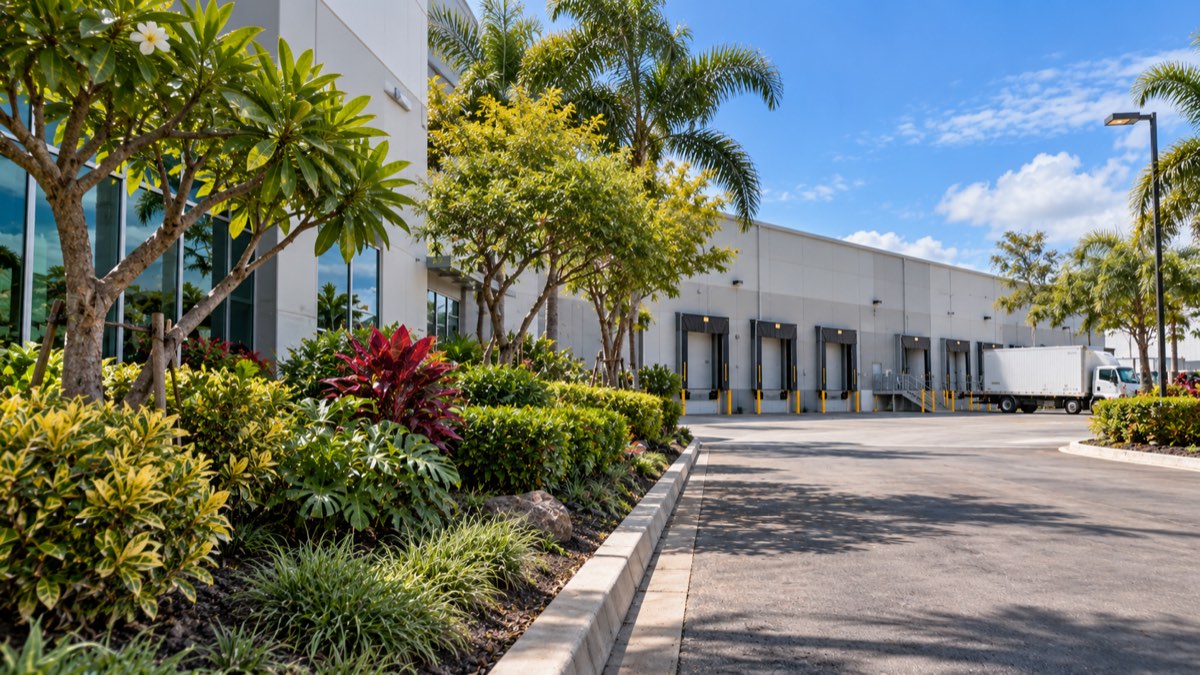
Industrial landscapes have different maintenance requirements from residential gardens. Beyond keeping the grounds presentable, property managers must consider how landscaping affects deliveries, employee access, service vehicles, and the daily operation of the property.
A hedge extending into a driveway, irrigation overspray reaching a loading area, or landscape debris accumulating near an entrance can become an operational concern. These problems are easier to manage when landscape maintenance is planned around how the property is used rather than treated as a separate activity.
At Pacific Island Landscape, we provide commercial landscape maintenance on Oahu through property-specific scopes of work. For industrial facilities, that means reviewing the landscape alongside access restrictions, maintenance requirements, and site operations before establishing a service plan.
Why Industrial Properties Need a Different Maintenance Plan
Industrial properties often have relatively simple landscaping compared with hotels or residential estates, but their maintenance requirements can be more complicated than they appear. Planting beds, turf, and hedges may sit directly beside loading docks, warehouse entrances, perimeter fences, employee parking areas, and vehicle access routes. Each location creates different considerations for pruning, irrigation, debris collection, and equipment access.
For example, a planting bed near an office entrance may require regular attention to appearance, while vegetation near a loading zone must also be maintained with vehicle clearance in mind. Even routine activities such as mowing or blowing should be coordinated with busy delivery periods to avoid unnecessary interruptions.
A property-specific maintenance plan helps address these differences from the beginning. During the initial property walk, we review the landscaped areas, discuss operational restrictions, and determine which maintenance responsibilities should be documented in the proposed scope of work.
What Should an Industrial Landscape Maintenance Contract Include?
A written maintenance agreement should clearly identify which areas receive ongoing care, what services are included, and which additional work requires separate approval. While every industrial property has different needs, several core maintenance activities are worth discussing.
Turf Management and Landscape Edges
Industrial properties may have turf surrounding offices, along internal roads, or near parking areas. Depending on the approved maintenance plan, routine care can include mowing, edging, aeration, and seasonal fertilization.
These areas should be identified during the property assessment so maintenance responsibilities are clear. Turf beside frequently used driveways may require additional coordination, while landscaped sections away from operational areas may be more straightforward to maintain.
Pruning and Vegetation Clearance
Hedges, shrubs, ground covers, and trees can interfere with property access when their growth is not managed. Regular pruning helps maintain the intended landscape appearance while addressing vegetation near pedestrian routes, gates, signs, and vehicle entrances.
Our commercial maintenance services include pruning and plant care, with more involved canopy work reviewed separately when necessary. The maintenance scope should distinguish routine vegetation management from specialty tree services so property managers understand what is covered under their agreement.
Irrigation Auditing and Minor Repairs
Irrigation problems can affect both plant health and surrounding paved surfaces. A leaking sprinkler, damaged irrigation head, or poorly directed spray may leave planting areas inadequately watered or create unwanted overspray near operational spaces.
Our commercial maintenance programs include irrigation inspections, head adjustments, and minor repairs. Larger repairs and mainline replacements require separate approval. For industrial properties, we recommend identifying irrigation zones near loading areas, equipment access points, and walkways during the assessment so their maintenance requirements can be considered alongside site operations.
Weed Control and Debris Management
Weeds and accumulated landscape debris can affect the appearance and usability of an industrial property's landscaped areas. Routine maintenance may include weed and pest control, clearing approved hardscape areas, and removing green waste generated during scheduled landscape work.
However, not every cleanup falls within a recurring maintenance agreement. Larger removals or unusual material requirements may need a separate scope. Our commercial debris and waste removal services address approved landscape materials, but do not include general junk or unrelated industrial waste.
Coordinating Landscape Maintenance With Daily Operations
Maintenance planning should account for how employees, visitors, delivery vehicles, and contractors move through the property. Even properly maintained landscaping can create unnecessary inconvenience when work is scheduled without considering normal business activities.
Loading Docks and Delivery Routes
Loading docks and delivery entrances deserve particular attention because they are frequently used by larger vehicles and service equipment. Vegetation around driveways, gates, and access points should be reviewed as part of the maintenance scope, especially where overgrowth could interfere with normal movement.
Before scheduling maintenance, property managers should communicate vehicle movement patterns, restricted parking areas, and locations where crews should avoid temporarily placing equipment or green waste. These requirements help establish a work plan that respects the property's operational needs.
Employee and Visitor Access
Landscaped areas around employee walkways and building entrances often receive regular foot traffic throughout the day. Activities such as mowing, blowing, pruning, and debris collection should therefore be considered alongside the periods when people typically enter or leave the building.
For some properties, work near entrances may be easier to coordinate during quieter operating periods. The appropriate arrangement depends on the site's schedule, access requirements, and the maintenance scope agreed upon by the property manager and contractor.
Restricted Areas and Property Rules
Industrial properties may have controlled entrances, security procedures, or areas that outside contractors cannot access without authorization. These requirements should be explained during the planning stage rather than discovered after maintenance work begins.
Property managers can help by identifying approved entry points, restricted landscape sections, equipment staging areas, and any relevant site procedures. We use these details when reviewing proposed maintenance responsibilities, with nonstandard access arrangements documented as part of the agreed scope.
How Oahu's Climate Affects Industrial Landscapes
Industrial landscapes across Oahu experience different growing conditions depending on their location, exposure, soil, and irrigation systems. Coastal sites may experience salt spray, while other properties may face stronger winds, frequent rainfall, or extended dry conditions.
These differences matter because maintenance routines suitable for one property may not address the needs of another. Plant growth, soil moisture, and irrigation coverage can vary across the island, making a site-specific assessment more useful than applying the same maintenance schedule everywhere.
Recognizing Plant-Health Problems
Discolored leaves, thinning hedges, declining turf, and unusual plant growth may indicate irrigation problems, environmental stress, insects, or disease. Because several conditions can produce similar symptoms, visible changes should be reviewed before a treatment is selected.
When plant-health concerns arise, we can assess the visible symptoms and determine whether a separate evaluation or treatment scope is appropriate. Our commercial disease control services address plant-health and insect concerns through property-specific reviews.
Treatment recommendations depend on the findings, and pesticide applications must follow the applicable product label. No treatment should be assumed to eliminate a problem or restore an affected plant.
When Industrial Properties Need More Than Routine Maintenance
Recurring maintenance helps manage established landscapes, but some problems require work beyond mowing, pruning, irrigation checks, and ordinary debris removal. Recognizing these differences helps property managers plan improvements without assuming every issue is covered by an ongoing contract.
For example, overgrown hedges may require a review of the pruning scope or maintenance frequency, while substantial tree damage could require a separate tree assessment. Irrigation leaks may be resolved through minor adjustments, but larger system failures can involve separately approved repairs. Similarly, deteriorated planting areas may need renovation rather than continued routine care.
Our commercial services include landscape design and installation alongside ongoing maintenance. When a property requires improvements beyond its current maintenance agreement, we can review the proposed work and prepare a separate scope that clarifies the responsibilities, exclusions, and approval requirements.
How to Evaluate an Industrial Landscape Maintenance Proposal
A useful maintenance proposal should explain more than the number of visits or the general services being offered. Property managers should understand exactly which areas will be maintained, how work will be coordinated, and what happens when an issue falls outside the routine agreement.
Before approving a proposal, consider the following questions:
- Are the maintained areas clearly identified? The agreement should distinguish the landscaped sections covered by the contract from excluded areas or spaces maintained by other providers.
- Does the schedule account for daily operations? Delivery activity, restricted areas, and heavily used entrances should be discussed before the work schedule is finalized.
- What irrigation work is included? Confirm the difference between regular inspections, minor repairs, and major repairs requiring separate authorization.
- How is additional work approved? Specialty tree services, substantial debris removal, irrigation replacements, and landscape renovations should have clear approval requirements.
- Who manages maintenance communication? Establishing the appropriate property contact and reporting expectations helps ensure concerns reach the person responsible for decisions.
These details make it easier to compare maintenance proposals based on their actual scope rather than price alone. They also help reduce confusion when new concerns arise during the contract.
What Determines Industrial Landscape Maintenance Pricing on Oahu?
Industrial landscape maintenance costs depend on the property and the services required, so there is no universal price that applies to every facility. The amount of landscaped space is important, but it is only one part of the overall scope.
Planting density, requested maintenance frequency, terrain, equipment access, irrigation requirements, green-waste removal, and operational restrictions can all influence the work involved. A property with limited landscaping may still require careful scheduling if its planting areas border active loading docks or restricted zones.
Properties with extensive hedging, mature trees, or complicated irrigation systems may require a broader scope than facilities with smaller, simpler planting areas. Comparing proposals therefore means reviewing what is included, which work is excluded, and whether additional services will need separate approval.
At Pacific Island Landscape, we review the property before preparing a written proposal. This allows us to identify the work required and provide pricing based on the approved scope rather than relying on a generic maintenance package.
Plan Industrial Landscape Maintenance With Our Team
Industrial landscape maintenance should support the property's daily operations while keeping its outdoor areas properly managed. A clear scope of work helps establish maintenance responsibilities, coordinate crew access, and identify when specialty work or additional approvals may be necessary.
We work with commercial property managers across Oahu to develop landscape maintenance scopes based on their property's condition, usage, and operational requirements. Our process begins with a request and property assessment, followed by a written proposal that outlines the recommended services and associated responsibilities.
If your industrial property needs ongoing landscape care, explore our commercial landscaping services or contact our team to request a property assessment.
You can also call 808-347-4462 to discuss your property's maintenance requirements.
Pacific Island Landscape | Kapolei, Oahu | License CT-35972