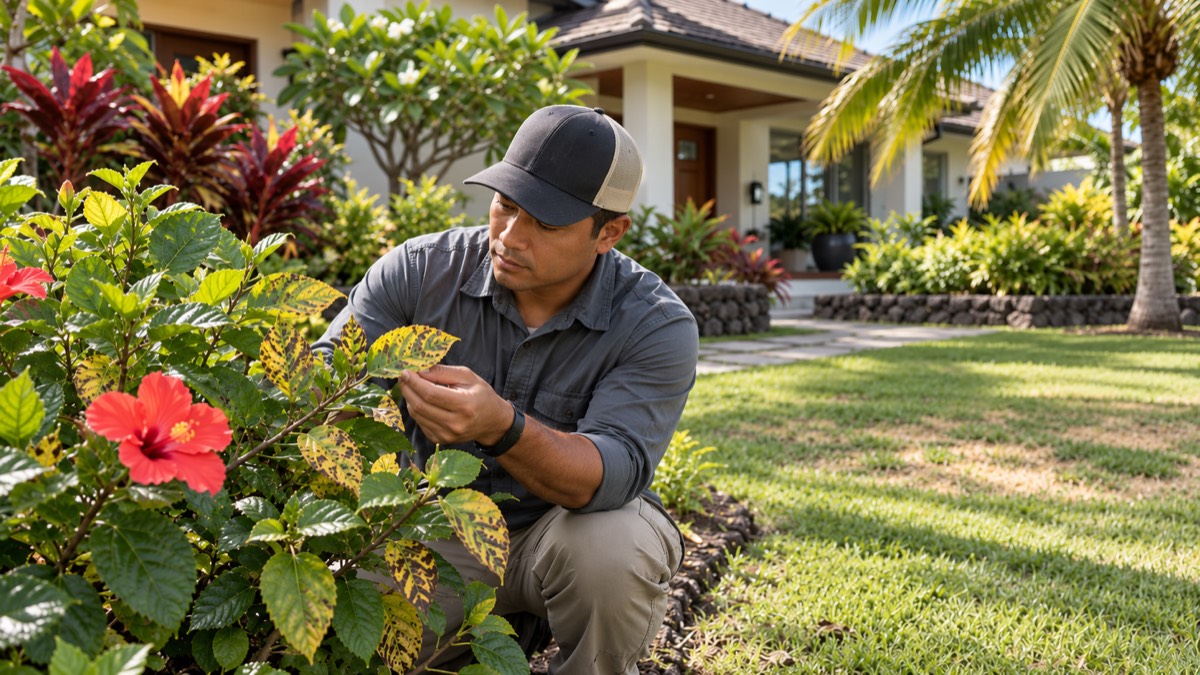
A hibiscus hedge develops dark spots. Several shrubs begin losing leaves. A palm that looked healthy a few weeks ago now has torn, uneven fronds.
When plants change suddenly, it's tempting to reach for a fungicide, increase watering, or remove the affected growth. But the wrong response can make the problem harder to identify.
On Oahu, landscape disease control starts with understanding what has changed and whether the cause is actually a disease. Irrigation problems, coastal exposure, insects, and root stress can produce symptoms that look remarkably similar.
We provide residential plant disease control and commercial plant disease control through property-specific services. This guide explains what to check when symptoms appear, which actions to avoid, and how to decide what happens next.
Start by Looking at the Pattern, Not Just the Damaged Leaves
An individual spotted leaf tells only part of the story. The location and distribution of symptoms can provide more useful clues.
Before making changes, walk the affected area and compare damaged plants with nearby healthy ones.
| What you notice | What may need investigation |
|---|---|
| Spots appearing across several plants | Possible foliar disease, shared growing conditions, or environmental injury |
| Yellow leaves and consistently wet soil | Excess moisture, poor drainage, or root problems |
| Brown leaf margins on exposed plants | Salt exposure, water stress, or other environmental injury |
| One declining section of a hedge | Irrigation coverage, root conditions, physical damage, or localized disease |
| Sudden wilting | Water availability, root function, or a possible pathogen |
| V-shaped cuts in palm fronds | Possible coconut rhinoceros beetle activity |
These observations are not diagnoses. More than one factor can affect the same plant.
For example, a shrub growing in poorly drained soil may develop root problems that make it more vulnerable to disease. Treating the visible foliage without examining the growing conditions may leave the underlying issue unresolved.
The first priority is determining whether the symptoms are isolated, spreading, or connected to a particular area of the property.
What to Do When You First Notice Plant Damage
A few careful observations can make the next assessment more useful.
1. Photograph the Symptoms Before Making Changes
Take photographs of individual leaves, the entire affected plant, and nearby plants showing similar symptoms.
Include wider photographs of the surrounding landscape. These may reveal whether damage is associated with an irrigation zone, a shaded area, or a particular planting bed.
Record when you first noticed the problem and whether its appearance has changed.
2. Check the Irrigation and Soil Conditions
Look for leaking sprinkler heads, unusually wet soil, dry patches, and water collecting around roots.
A plant may wilt because it lacks water, but it may also wilt when waterlogged or damaged roots cannot function properly.
Avoid automatically increasing watering. First compare the affected area with nearby healthy planting.
3. Review Recent Landscape Work
Consider whether symptoms appeared after pruning, planting, irrigation adjustments, or nearby construction.
Recent activity does not necessarily explain the problem, but it gives the person evaluating the landscape important context.
4. Avoid Applying Products Based on Appearance Alone
Leaf spots do not automatically mean a fungicide is needed. Yellowing does not automatically indicate fertilizer deficiency.
Different diseases, insect problems, and environmental conditions may require entirely different responses.
If treatment is necessary, product selection must match the identified concern and the approved use listed on the label.
5. Track Whether the Problem Is Spreading
Mark the affected plants on a simple property plan or take photographs from the same position over time.
Look for newly affected growth, additional damaged plants, or changes in symptom severity.
For commercial properties, a simple record identifying the affected landscape zone can also help maintenance teams avoid repeating assessments without documenting what changed.
Why Oahu's Microclimates Matter
Landscape disease risks vary considerably across Oahu.
According to the Rainfall Atlas of Hawaii, rainfall patterns differ sharply between wetter windward slopes and drier leeward areas.
That difference affects plant moisture, irrigation needs, and environmental stress.
Windward Properties: Watch Persistent Moisture
In wetter locations such as Kaneohe, frequent rainfall and longer periods of leaf wetness can create conditions favorable to certain fungal and bacterial diseases.
Dense planting and limited airflow may allow foliage to remain wet longer.
Property owners should pay attention to persistent moisture, crowded plantings, and drainage around sensitive plants.
Leeward Properties: Investigate Irrigation and Heat Stress
In drier areas such as Kapolei, prolonged dry conditions may increase reliance on irrigation.
An improperly adjusted sprinkler can leave one section of a landscape dry while supplying excessive water to another.
Coastal properties may also experience salt exposure, which can damage foliage without an infectious disease being present.
Seasonal Changes Require Different Checks
Hawaii generally experiences a wetter season from approximately November through April and a drier season from May through October, although local rainfall varies.
During wetter periods, monitor leaf wetness, drainage, and recurring foliage symptoms.
During drier periods, focus on irrigation performance, root-zone moisture, and signs of plant stress.
Neither season eliminates disease risk. Oahu's relatively warm conditions allow many landscape plants and disease organisms to remain active throughout the year.
When Palm Damage Is Actually an Insect Problem
Not every declining palm has a disease.
One important threat on Oahu is the coconut rhinoceros beetle (CRB), which damages palms by boring into the crown and feeding on developing tissue.
As damaged fronds emerge, they may display distinctive V-shaped cuts or holes. These symptoms can be confused with other forms of palm decline.
The Coconut Rhinoceros Beetle Response Program provides identification information and current reporting guidance.
We also provide CRB evaluation and treatment for residential properties.
CRB treatment is separate from general disease control. The appropriate response depends on visible evidence, the affected palms, and the agreed scope of work. Treatment does not guarantee that a palm will recover.
If you suspect CRB, document the damage and review current official guidance before disturbing potentially infested material.
When Professional Disease Control Is Worth Considering
Not every damaged leaf requires professional intervention. Isolated older foliage or a minor change associated with known environmental conditions may simply warrant observation.
A more detailed evaluation becomes useful when:
- Symptoms continue spreading despite correcting an obvious maintenance issue.
- Several plants begin declining within the same landscape area.
- Valuable mature plantings show progressive damage.
- The cause remains unclear after checking irrigation and growing conditions.
- The affected area is important to property access, presentation, or ongoing landscape operations.
We begin by reviewing the affected plant material and observable site conditions.
Our recommendations depend on the specific property. A proposed service may involve adjustments to landscape care, removal of affected material, or a targeted treatment when appropriate.
A site review does not automatically establish a laboratory-confirmed diagnosis.
When specialist testing is needed, the University of Hawaii's Agricultural Diagnostic Service Center provides plant disease diagnostic services. Testing arrangements and responsibilities must be confirmed separately.
What Happens After the Cause Is Evaluated?
There is no single treatment that works for every plant-health problem.
The response should address the likely cause rather than simply covering the visible symptoms.
Correct the Growing Conditions
Some situations call for irrigation adjustments, improved airflow, or changes to routine plant care.
For example, correcting an irrigation issue may be more relevant than applying a fungicide when plants are declining because of unsuitable soil moisture.
These changes need to be evaluated for the affected plant and property. They should not be treated as universal remedies.
Consider Targeted Treatment
When a disease or insect concern justifies a pesticide application, the selected product must be registered and labeled for the intended use.
Hawaii's Department of Agriculture and Biosecurity pesticide guidance explains registration and label requirements.
Application restrictions, protective measures, and access instructions depend on the actual product and site conditions.
We document proposed treatments within a property-specific scope rather than treating every plant-health concern with the same approach.
Decide Whether Removal Is More Appropriate
Some plants are too severely declined to justify further treatment, while others may remain candidates for continued care.
The decision depends on their condition, the suspected cause, and the risk to surrounding plants.
If removal is appropriate, the scope should specify which plants are involved and how the material will be handled.
We also provide landscape debris and waste removal for approved material. Removal, stump work, and other related tasks must be included in the agreed scope rather than assumed to be part of disease treatment.
Replacement planting can be considered separately. We operate a private landscape nursery on Oahu, with plant selections and availability confirmed for each project.
Build a Prevention Routine Around Your Property
Preventing repeated problems is less about following a universal spray schedule and more about understanding what regularly stresses the landscape.
For Oahu properties, that means incorporating several checks into ongoing maintenance.
During wetter periods:
- Look for standing water and blocked drainage paths.
- Check whether dense foliage is staying wet for prolonged periods.
- Review pruning needs where airflow is limited.
- Watch for symptoms appearing on multiple plants.
During drier periods:
- Inspect irrigation heads and coverage patterns.
- Check soil moisture before changing watering schedules.
- Watch exposed plants for possible salt or heat stress.
- Record recurring dry patches or unusual leaf loss.
Keep mulch away from direct contact with trunks and sensitive stems, and use pruning practices appropriate to the plant.
If an infectious problem is suspected, avoid transferring potentially affected material between planting areas until proper handling is established.
For commercial properties, these observations can be incorporated into a documented landscape maintenance scope. For private estates, routine care can similarly help identify changes before more extensive corrective work is considered.
Monitoring can reduce uncertainty, but it cannot promise that every disease or insect problem will be prevented.
Know What You're Authorizing Before Treatment Begins
A plant-health proposal should make clear what is being evaluated and what work is actually included.
Before approving a service, confirm the affected landscape areas, the proposed response, and whether additional specialist diagnosis is needed.
Also ask whether the proposal includes follow-up visits, irrigation repairs, plant removal, or off-site debris hauling. Those services should not be assumed unless they are documented.
For commercial properties, access arrangements and responsibilities around occupied areas may also need to be addressed before work begins.
We define our services through written, property-specific scopes so the requested work and any exclusions are clear before scheduling.
Get a Plant-Health Review for Your Oahu Property
If your landscape is showing unexplained spots, yellowing, wilting, or progressive decline, the next step is to understand what is happening before choosing a treatment.
We provide disease-control services for commercial properties and residential estates across Oahu. Our review considers observable plant conditions and relevant site factors before a proposed scope is prepared.
Request a landscape quote to tell us about the affected plants and arrange the next step for your property.
You can also call 808-347-4462.
Pacific Island Landscape | Hawaii Contractor License CT-35972