
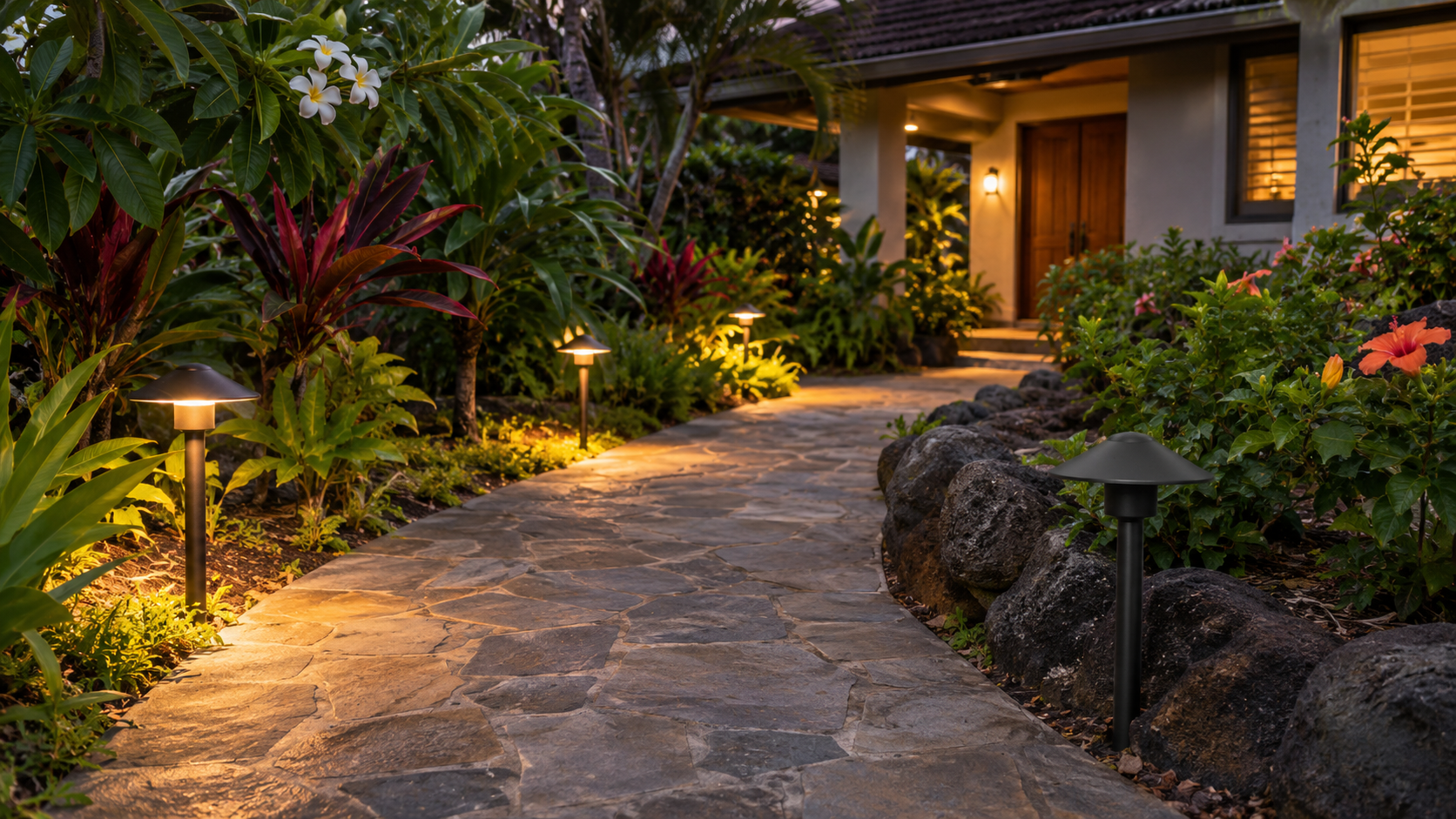
Outdoor landscape lighting can make pathways easier to navigate after dark and highlight the plants that define your property. But when fixtures start flickering, become unusually dim, or stop working altogether, finding the cause isn't always straightforward.
On Oahu, landscape lighting systems are exposed to moisture, irrigation spray, and coastal conditions that can affect outdoor equipment over time.
At Pacific Island Landscape, we offer residential low-voltage landscape lighting across Oahu. We take the time to walk your property, check your setup, and figure out exactly what your yard needs before diving in.
If your outdoor lighting isn't performing as expected, here's what might be happening and what to check before considering repairs or replacement.
Why Do Low-Voltage Landscape Lights Stop Working?
Low-voltage landscape lighting systems use a transformer to supply reduced electrical voltage to outdoor fixtures.
The system may also include timers, photocells, underground cables, and electrical connections.
A problem with any of these components can affect lighting performance.
Common symptoms include:
- One fixture stops illuminating.
- Several lights on the same cable run go dark.
- Lights flicker or turn on intermittently.
- Fixtures become noticeably dimmer.
- The entire lighting system stops operating.
- Lights turn on or off at unexpected times.
These symptoms can help narrow down the problem, but they don't confirm which component has failed.
If you're experiencing issues with your low-voltage lighting, checking the manufacturer's troubleshooting guide can be a helpful first step in figuring out what might be causing the problem.
Problem 1: One Landscape Light Isn't Working
When one fixture stops working while nearby lights remain illuminated, the issue may be limited to that fixture or its connection.
Possible causes include a failed lamp or LED module, moisture inside the housing, or a damaged connector.
Start with a visual inspection.
Look for obvious damage, loose fixture positioning, or water accumulation around the fixture.
If the lighting system uses replaceable lamps, consult the manufacturer's instructions before attempting replacement.
Avoid opening electrical components or disturbing buried wiring without the appropriate knowledge and equipment.
When fixture replacement may be necessary
A fixture with extensive corrosion, damaged seals, or failed internal components may need replacement.
However, replacing the fixture without checking its power supply and connections might not resolve the problem.
For existing systems, component compatibility should be confirmed before new equipment is selected.
Problem 2: Several Landscape Lights Are Out
When multiple fixtures stop working together, the problem may involve a shared cable run, transformer, or control component.
For example, damaged underground wiring can interrupt power to several connected fixtures.
Recent planting, edging, or other landscape work may also affect cable routes if their locations were not identified beforehand.
Before requesting service, note which fixtures are working and which are not.
This information can help identify whether the issue appears isolated or affects a larger section of the system.
Check the timer or controller settings
Sometimes the lighting system itself is functional, but its operating schedule has changed.
Check accessible timer settings according to the manufacturer's instructions.
If the entire system stopped working after a power interruption, the controller may need its schedule reviewed.
If a breaker or ground-fault protection device repeatedly trips, do not bypass it or continue resetting it. Have the electrical issue evaluated by an appropriately qualified professional.
Problem 3: Lights Flicker or Become Dim
Flickering or dim landscape lights can indicate problems with electrical connections, damaged cables, or the voltage reaching individual fixtures.
Cable length and the number of connected lights can affect system performance.
Voltage drop in low-voltage systems
Voltage drop occurs when electrical resistance reduces the voltage delivered along a cable.
Long cable runs and higher connected loads can contribute to this problem.
If fixtures near the transformer appear bright while distant fixtures are dimmer, the cable layout and equipment capacity may deserve evaluation.
Adding more fixtures without reviewing the existing transformer can create further performance problems.
At Pacific Island Landscape, we check your current setup and talk through how you want your yard to look before making any changes.
We always make sure your transformer can handle extra load before plugging in new lights.
Problem 4: Outdoor Lighting Fails After Rain
If your landscape lighting stops working after heavy rain or irrigation, moisture exposure may be contributing to the problem.
Outdoor fixtures and connections need to be suitable for their installation environments.
Potential issues include:
- Water entering damaged fixture housings
- Deteriorating seals
- Moisture affecting cable connections
- Corrosion on exposed metal components
- Irrigation spray repeatedly reaching vulnerable equipment
A fixture may appear normal from the outside even when its internal components have deteriorated.
Why Oahu's coastal conditions matter
Properties exposed to salt air may experience additional corrosion concerns.
Materials, protective finishes, and equipment ratings should be appropriate for the location.
A coastal property in an exposed area may require different equipment considerations from a more sheltered inland landscape.
We tailor our recommendations to your neighborhood's microclimate so your fixtures stand up to the elements.
Problem 5: Plants Are Blocking the Lights
Not every outdoor lighting problem involves electrical equipment.
On Oahu, year-round plant growth can change how a lighting system performs.
A fixture originally positioned to highlight a specimen tree may eventually be hidden by nearby shrubs.
Similarly, overgrown plants can block pathway lighting or create unwanted shadows.
Before assuming a fixture is malfunctioning, check whether vegetation is obstructing the beam.
Adjusting lights as the landscape grows
Minor changes to nearby planting may improve the intended lighting effect.
However, fixture relocation or adjustments to cable routing should be evaluated before work begins.
Our residential estate maintenance services can help keep vegetation well-maintained as part of your customized landscape care plan.
For lighting adjustments or electrical repairs, our team can help clarify what’s covered and guide you toward the right solution for your property.
When Should You Request a Professional Lighting Assessment?
Some problems can be identified through basic observations, such as checking timer settings or noticing vegetation blocking a fixture.
Others require equipment testing or electrical work.
Consider requesting a professional assessment when:
- Multiple fixtures stop working.
- Lights repeatedly flicker or become dim.
- Water appears inside lighting equipment.
- Wiring or connections show visible damage.
- A transformer or controller appears faulty.
- You want to add new fixtures to an existing system.
- Lighting performance changes after landscape renovations.
Work involving household-voltage circuits, electrical panels, or other regulated electrical components must be handled by appropriately qualified professionals.
Our low-voltage lighting services do not automatically include these responsibilities.
Repair, Upgrade, or Replace: Which Makes Sense?
Not every lighting problem requires a completely new system.
The appropriate solution depends on the condition of the equipment, compatibility of replacement components, and the property's lighting requirements.
For older systems, upgrading selected equipment may be worth considering.
However, new fixtures should not be added until the existing system's capacity and compatibility are understood.
A quick on-site check helps us see whether simple fixes, smart upgrades, or a fresh layout will give you the best results.
Request a Landscape Lighting Assessment on Oahu
Landscape lighting problems can arise from equipment wear, environmental exposure, or changes in the surrounding landscape.
Identifying the likely cause before replacing components helps define the work needed.
At Pacific Island Landscape, we provide low-voltage landscape lighting services for residential estates and commercial properties across Oahu.
Whether you want to fix an existing system or upgrade your layout, we're happy to drop by, take a look, and discuss the best options for your home.
Get in touch with Pacific Island Landscape or call 808-347-4462 to schedule an on-site lighting assessment and free estimate today.