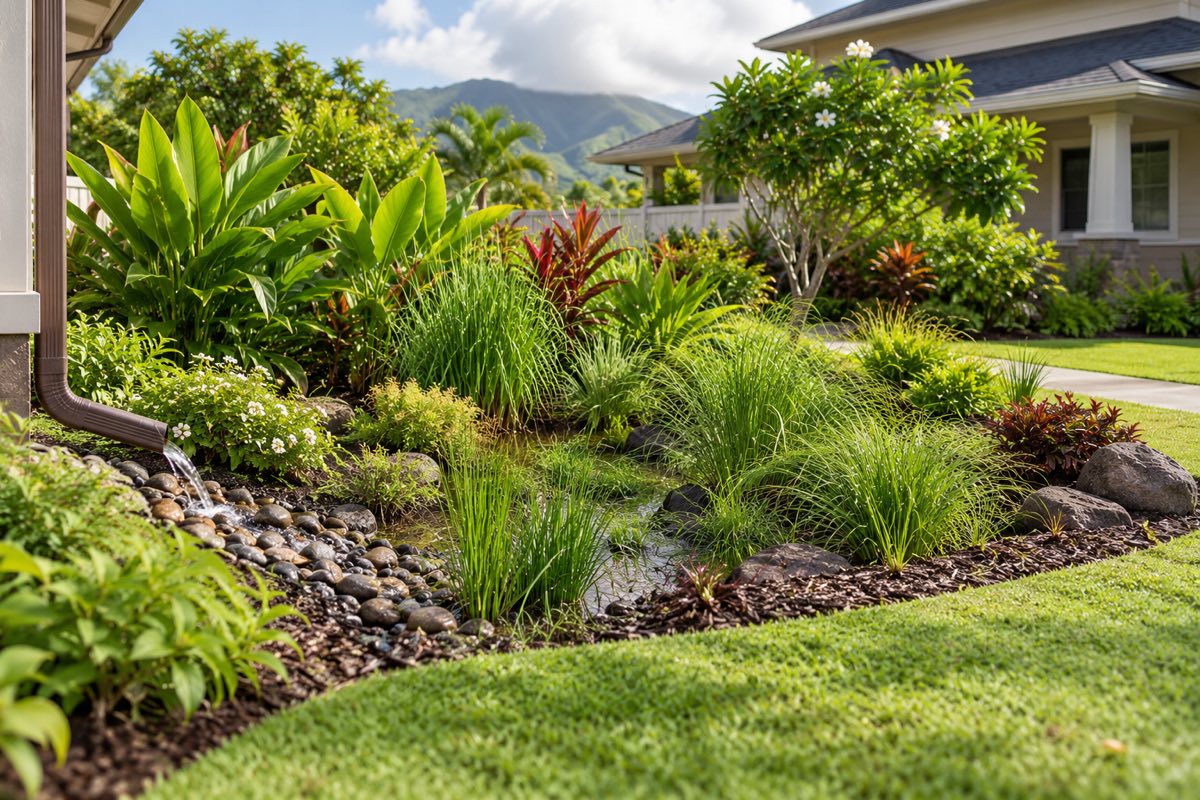
Heavy rainfall can leave Oahu properties with standing water, eroded planting beds, and runoff flowing across driveways or paved areas. A properly located rain garden can help manage some of that water while adding a planted feature to the landscape.
Unlike an ordinary garden bed, a rain garden is a shallow depression designed to receive runoff from surfaces such as roofs, patios, and driveways. Water collects temporarily, then gradually infiltrates the soil.
For homeowners and property managers considering rain garden installation on Oahu, the important questions are whether the property is suitable, how much installation might cost, and which plants can tolerate changing moisture conditions.
In this guide, we explain the costs, site considerations, installation process, and maintenance requirements that matter in Hawaii's varied growing conditions.
How Much Does Rain Garden Installation Cost on Oahu?
Professional rain garden installation is commonly estimated at approximately $10 to $25 per square foot in national consumer cost guides, while DIY material costs may range from $3 to $10 per square foot.
These are broad planning figures, not verified Oahu contractor prices. Actual local costs depend on site conditions, material requirements, labor, and the installation scope.
Illustrative rain garden cost estimates
| Garden size | DIY materials | Professional installation |
|---|---|---|
| 100 sq. ft. | 300- 1,000 | 1,000 - 2,500 |
| 150 sq. ft. | 450 - 1,500 | 1,500 - 3,750 |
| 200 sq. ft. | 600 - 2,000 | 2,000 - 5,000 |
Illustrations calculated from national cost ranges. Not Oahu quotations or client pricing.
Several factors can affect your installation budget:
- Soil conditions: Slowly draining soil may require additional excavation, amended planting media, or a different drainage approach.
- Property slope: Sloped sites need careful consideration of grading, stability, and the direction of overflow.
- Accessibility: Narrow side yards, retaining walls, and limited equipment access can complicate excavation.
- Plants and materials: Plant quantities, soil specifications, mulch, and drainage components influence the final scope.
- Excavation and hauling: Removed soil, sod, and other landscape debris must be accounted for.
When comparing quotes, ask whether excavation, planting media, inlet construction, overflow provisions, planting, and material removal are included.
We prepare property-specific landscaping proposals after reviewing the requested work and site conditions. Our residential landscaping services explain how we define installation responsibilities and identify work requiring separate professional review.
Why Rain Gardens Make Sense in Hawaii
Rain gardens capture runoff that would otherwise flow quickly across hard surfaces and into drainage systems.
As the water moves through vegetation and soil, the garden can help slow runoff and filter some pollutants. This is particularly relevant on an island where stormwater can carry sediment toward streams and coastal waters.
The U.S. Environmental Protection Agency's rain garden guidance explains how planted depressions can support runoff management and improve landscape function.
Rainfall conditions differ considerably across Oahu. Windward neighborhoods generally receive more rainfall than many leeward areas, although actual conditions depend on a property's elevation and exposure.
That means rain garden design should reflect the specific property rather than follow a single islandwide layout.
Rain Garden vs. Rain Barrel vs. Bioswale
| Feature | Main function | Typical application |
|---|---|---|
| Rain garden | Temporarily collects runoff and allows infiltration | Suitable residential or landscaped areas |
| Rain barrel | Stores collected rainwater for later use | Roof runoff collection |
| Bioswale | Slows, conveys, and may treat runoff through a vegetated channel | Larger landscaped drainage corridors |
Rainwater collection is generally permitted in Hawaii, although water-quality requirements and intended uses matter. A rain barrel stores water, while a rain garden generally allows captured runoff to enter the ground.
A bioswale may be more appropriate for a linear drainage area, but larger commercial stormwater systems require design appropriate to the site's drainage obligations.
Choosing the Right Location for an Oahu Rain Garden
Placement determines whether a rain garden manages runoff effectively or creates additional drainage problems.
Before excavation, identify where water enters the property, how it currently travels, and where excess water can safely go during heavy rainfall.
Important site considerations include:
- Distance from buildings: Many residential rain garden guides recommend a minimum separation of approximately 10 feet from foundations. Actual requirements depend on the site and applicable guidance.
- Utilities: Identify underground utilities before excavation. Private irrigation and electrical lines may require additional locating.
- Slope: Avoid assuming a steep yard can accommodate a simple excavated basin without professional evaluation.
- Existing drainage: The garden must receive runoff without directing overflow toward structures or neighboring properties.
- Soil infiltration: Confirm that the soil drains adequately and that groundwater or subsurface conditions do not make infiltration unsuitable.
An important starting point is the Hawaii Residential Rain Garden Manual from Hui o Ko'olaupoko. It addresses local rainfall, soil conditions, drainage areas, and residential rain garden construction.
Test the Soil Before Choosing a Size
A preliminary infiltration check can help identify whether a proposed location deserves further investigation.
Dig a small test hole, fill it with water, and observe the drainage rate. A single test does not establish the site's final design infiltration rate, particularly where soils vary across the property.
Many rain garden guides aim for temporary ponding to clear within approximately 24 to 48 hours. Persistent ponding can indicate unsuitable soil, inadequate infiltration, or another drainage issue.
You can also review mapped soil information through the USDA Web Soil Survey, although field conditions should still be checked.
How Large Should a Rain Garden Be?
The required size depends on the amount of runoff entering the basin, the soil's infiltration capacity, and the intended ponding depth.
A roof downspout serving a small drainage area creates different demands from several paved surfaces draining toward one low point.
The practical approach is to:
- Measure the roof or paved area directing water toward the proposed garden.
- Check site-specific soil infiltration.
- Use an appropriate rain garden sizing method for local rainfall.
- Plan how excess water will leave the garden during storms.
Avoid sizing the basin based solely on appearance. A rain garden that cannot handle its contributing runoff may overflow in unintended directions.
Step-by-Step Rain Garden Installation Process
Once suitability and sizing have been established, installation generally follows a series of site-preparation and planting steps.
1. Mark and excavate the basin
Mark the approved garden footprint and remove soil to the depth required by the design. Maintain appropriate elevations so incoming water spreads through the intended ponding area.
2. Prepare the planting soil
The planting media must support both infiltration and plant growth. Sand, soil, and compost may be used in specified proportions, but the correct mix depends on the site's conditions and design guidance. Avoid compacting the finished planting area.
3. Create the inlet, berm, and overflow
The inlet directs runoff into the basin. A properly shaped berm may retain temporary ponding, while the overflow provides an intended exit for water exceeding the garden's capacity. The overflow must not create problems elsewhere on the property.
4. Install plants and mulch
Arrange plants according to their tolerance for occasional inundation and dry periods. Apply appropriate mulch while keeping inlets and overflow points clear.
5. Inspect drainage and establish the planting.
After installation, observe how water enters, ponds, and exits during rainfall. Newly installed plants may need supplemental watering while they establish, even when the garden is intended to collect rainwater.
Our residential landscape installation services can include approved grading, planting, irrigation, and landscape drainage work.
Rain garden construction or drainage components would need to be reviewed and explicitly included in the project scope. Engineered stormwater systems, structural issues, and permit-dependent design may require separate qualified professionals.
Plants to Consider for an Oahu Rain Garden
Rain garden plants must handle changing moisture conditions. The bottom of the basin receives the most water, while the slopes and upper edges generally drain sooner.
Hawaii's growing conditions also vary with sun exposure, salt spray, and local rainfall.
The Hawaii Residential Rain Garden Manual provides plant-selection guidance suited to different rainfall conditions and planting zones.
Three planting zones to plan for:
- Basin - Wettest area; select plants proven to tolerate temporary ponding.
- Slope - Transitional area; choose plants suited to changing soil moisture.
- Berm - Drier upper edge; choose plants that prefer less frequent saturation.
Examples identified in Hawaii rain garden guidance include ʻahuʻawa for basin conditions, kupukupu for some slope positions, and ʻakia for suitable slopes or berms.
These are examples to evaluate, not a universal planting specification. Confirm the current botanical identification, site suitability, available growing space, and planting-zone tolerance before purchasing.
Species such as ʻilima and naupaka may suit other landscape areas, but they should not automatically be placed where runoff collects.
We also recommend checking proposed plants against the Plant Pono resources to reduce the risk of introducing invasive species.
Our Kapolei nursery supports our wider landscape projects, with material availability checked before selections are confirmed. Specific rain garden plant inventory must be verified for each project.
Rain Garden Maintenance in Hawaii
Rain gardens are not maintenance-free. Water movement, plant establishment, and accumulated debris should be monitored to keep the installation functioning as intended.
| When | What to check |
|---|---|
| During establishment | Plant watering needs, weeds, and signs of stress |
| After significant rainfall | Inlets, sediment accumulation, erosion, and overflow |
| During routine landscape care | Plant density, mulch condition, weeds, and drainage performance |
| When water remains too long | Potential clogging, soil compaction, or another infiltration problem |
Standing water deserves attention. If the basin consistently fails to drain within its intended period, investigate the cause rather than adding plants or digging deeper without a plan.
Keep edible crops outside areas receiving potentially contaminated driveway or roadway runoff. Raised growing beds in separate locations are generally a more appropriate option.
Consider Coconut Rhinoceros Beetle Risks
Green waste, compost, and decomposing plant material can create conditions associated with coconut rhinoceros beetle breeding.
Follow current CRB Hawaii guidance for managing potentially affected organic material. Avoid leaving unmanaged piles of decomposing vegetation around landscape projects.
We provide CRB evaluation and treatment services under separately defined scopes where appropriate. Treatment does not guarantee eradication or palm recovery.
Excavated soil, sod, and approved landscape debris may also be addressed through our residential debris and waste removal service. Excavation and hauling are separate tasks unless both are included in the agreed scope.
DIY or Professional Rain Garden Installation?
A small rain garden may be suitable for a homeowner-led project when the site has favorable drainage conditions and a straightforward runoff source.
However, professional evaluation becomes more important when the property has:
- Steep slopes or retaining walls
- Persistent standing water near a building
- Significant paved drainage areas
- Underground utility conflicts
- Commercial stormwater requirements
- Uncertain soil infiltration or overflow conditions
Before proceeding, check applicable permits with the Honolulu Department of Planning and Permitting. Requirements depend on the nature and extent of the proposed work.
When comparing contractors, ask how soil infiltration will be assessed, who is responsible for drainage design, what installation components are included, and how the completed garden will be maintained.
We approach landscape projects through a property review followed by a written scope. Where drainage conditions require civil, structural, or other specialist input, those responsibilities must be addressed separately.
Planning a Rain Garden for Your Oahu Property
A rain garden can be a practical addition to a landscape when the location, drainage conditions, and planting plan are suitable.
The priority is understanding how water moves across your property before selecting a garden shape or plant palette. Soil performance, grading, overflow, and ongoing care are all part of that decision.
If you're considering a rain garden as part of a larger residential or commercial landscape improvement, we can review your property's landscape requirements and determine which work falls within our services.
Request a Landscape Quote to share your property details and arrange the next step in evaluating your project.
Pacific Island Landscape | Oahu Landscape Contractor
Phone: 808-347-4462
Hawaii Contractor License: CT-35972