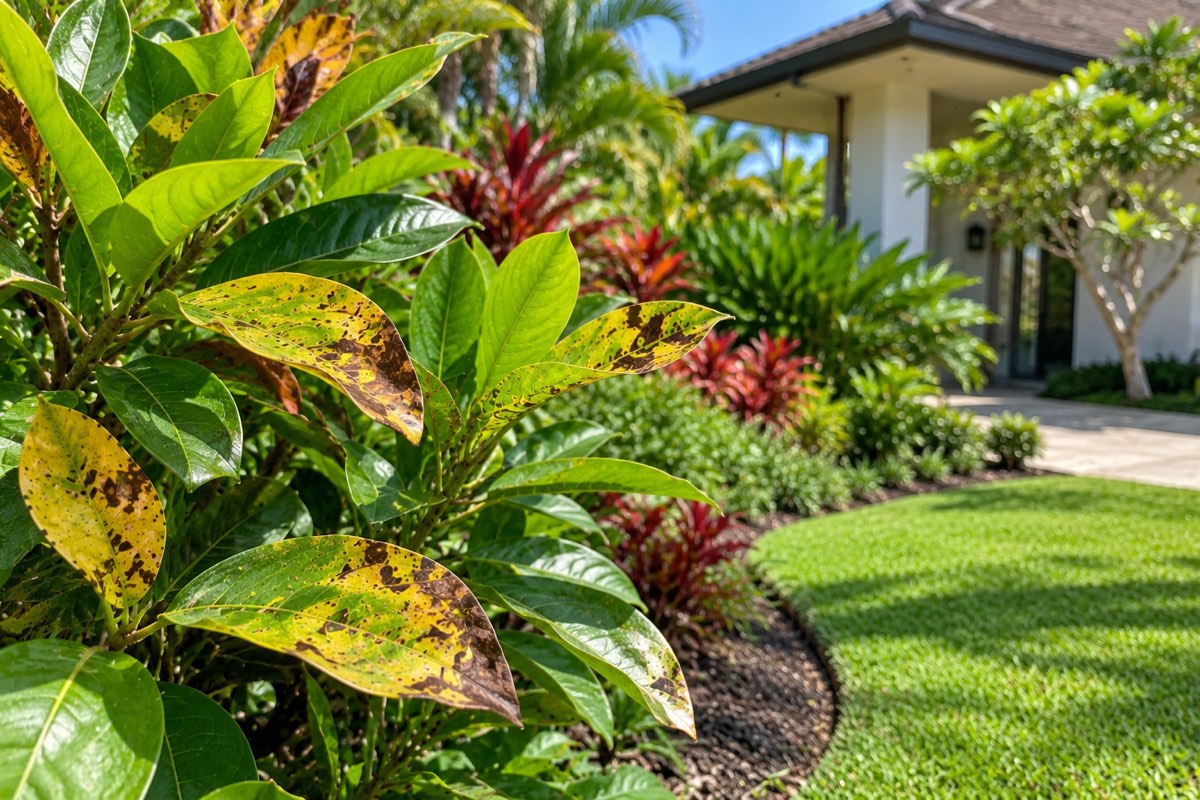
Brown patches on ornamental shrubs, yellowing foliage, or a declining palm can change the appearance of an otherwise well-maintained Honolulu landscape. But treating visible damage without understanding its cause may waste money and leave the underlying problem unresolved.
What looks like disease could be related to excessive moisture, salt exposure, insect activity, or unsuitable growing conditions.
Professional residential landscape disease control begins with understanding those differences. For homeowners, the important questions are what should be evaluated, which treatments may be appropriate, and what to look for before approving a service proposal.
At Pacific Island Landscape, we provide residential plant disease control on Oahu. Our approach begins with reviewing visible plant symptoms and property conditions before defining the proposed work.
How to Recognize Possible Landscape Disease in Your Honolulu Yard
Not every discolored leaf indicates an infection. Several unrelated problems can produce similar symptoms, particularly in landscapes exposed to varying sunlight, rainfall, and coastal conditions.
The following signs can help you decide what needs closer attention.
| Visible symptom | Possible explanation | What to check |
|---|---|---|
| Brown or black leaf spots | Disease, physical injury, or environmental stress | Whether spots are spreading or affecting nearby plants |
| Yellowing leaves | Water stress, root problems, or nutrient imbalance | Soil moisture and irrigation coverage |
| Wilting foliage | Inadequate water or impaired root function | Whether the soil is unusually dry or consistently saturated |
| Branch dieback | Root problems, disease, or other damage | Which branches are affected and how quickly decline develops |
| White powdery growth | Possible powdery mildew | Distribution and appearance of the growth |
| Damaged palm fronds | Insect feeding, including possible CRB activity | Cuts in emerging fronds or visible crown damage |
These observations are clues, not confirmed diagnoses.
The University of Hawaii's plant diagnostic guidance emphasizes examining multiple affected plant parts because one symptom may not reveal the complete problem.
If several plants begin declining or a valuable specimen deteriorates quickly, arrange a closer evaluation rather than repeatedly applying general-purpose treatments.
Disease, Environmental Stress, or Coconut Rhinoceros Beetles?
One of the most important steps in managing landscape problems is separating infectious disease from noninfectious damage.
Plant disease
Fungi, bacteria, and other pathogens can cause leaf spots, blights, root problems, or plant decline.
Moist conditions and prolonged leaf wetness can encourage certain diseases. However, treatment depends on the actual pathogen, host plant, and growing environment.
Environmental stress
Honolulu properties can experience considerably different growing conditions.
Coastal landscapes may face salt exposure and wind. Poor drainage can leave roots in persistently wet soil, while uneven irrigation may create dry areas elsewhere on the same property.
Correcting the growing conditions may be more useful than applying a disease-control product when the problem is environmental.
Coconut rhinoceros beetle activity
Palm damage deserves separate consideration.
Coconut rhinoceros beetles (CRB) can bore into palm crowns, leaving distinctive V-shaped cuts or other damage visible as fronds emerge.
These signs warrant examination but do not confirm an infestation by themselves.
We offer a separate residential CRB evaluation and treatment service. Depending on the palm and site conditions, proposed treatment may involve injection or soil drenching when permitted by the selected product label.
No single treatment can be assumed to eliminate CRB activity or restore previously damaged palm tissue.
For additional identification help, homeowners can consult CRB Hawaii's official resources.
What Professional Residential Landscape Disease Control Involves
A professional plant-health service should do more than select a product based on a photograph.
The work should follow a defined evaluation and treatment process appropriate to the property.
1. Review the affected landscape
The initial review considers which plants are affected, the visible damage, and relevant site conditions.
We examine observable landscape factors such as irrigation coverage, drainage conditions, and the distribution of symptoms. Recent planting or maintenance work may also provide useful context.
Some problems require laboratory testing or evaluation by a specialist. Those services are not automatically part of our standard disease-control scope.
2. Recommend an appropriate response
Not every plant-health concern requires chemical treatment.
Depending on what the evaluation supports, recommendations may involve adjusting irrigation, addressing landscape maintenance conditions, removing affected material, or proposing a targeted treatment.
Where a pesticide is appropriate, the selected product's label governs the permitted application and required precautions.
3. Define removal and disposal responsibilities
Severely affected plants sometimes require further evaluation to determine whether treatment or removal is appropriate.
Pruning, plant removal, stump work, and hauling should be clearly identified rather than assumed to be included in disease treatment.
We can coordinate separately approved residential landscape debris and waste removal where appropriate.
If coconut rhinoceros beetle breeding material is suspected, it may require specific handling or treatment before movement.
4. Establish follow-up expectations
Plant response can depend on the cause, severity of damage, and subsequent growing conditions.
Some situations require additional observation or treatment. Others may involve correcting conditions and monitoring new growth.
We document any agreed follow-up responsibilities in the service scope. A treatment proposal should not be interpreted as a promise of plant recovery.
How to Reduce Recurring Plant-Health Problems
Treating an affected plant may not resolve the conditions contributing to its decline.
For Honolulu homeowners, ongoing landscape management can help identify developing concerns and address maintenance issues before they become more extensive.
Consider the following practices:
- Review irrigation regularly. Check whether water is reaching the intended planting zones without leaving certain areas consistently saturated.
- Maintain appropriate airflow. Pruning and plant spacing can help reduce prolonged moisture on foliage, depending on the species.
- Manage landscape debris. Remove approved fallen branches, damaged foliage, and other plant waste when appropriate for the particular issue.
- Watch for recurring symptoms. Record whether similar damage returns to the same plant or appears elsewhere in the landscape.
- Choose plants for their growing conditions. Consider sun, wind, drainage, and salt exposure before replacing a declining specimen.
These practices can reduce some contributing conditions, but they cannot prevent every disease or insect problem.
Our residential landscape maintenance services provide ongoing estate care through documented maintenance programs. Plant-health monitoring and any specialized treatment should be confirmed within the agreed scope.
Choosing Plants That Suit Honolulu's Growing Conditions
Plant selection affects how a landscape responds to local environmental stress.
A planting that performs well in a protected courtyard may struggle in a coastal yard exposed to salt-laden winds. Likewise, a species that tolerates drier conditions may develop problems in poorly drained soil.
Before selecting replacement plants, consider:
- Sun exposure: Whether the planting area receives direct sunlight, partial shade, or prolonged shade.
- Water and drainage: How quickly the soil drains after irrigation or rainfall.
- Wind and salt: Whether the planting area is exposed to coastal conditions.
- Mature size: Whether the plant has sufficient room for healthy growth and routine maintenance.
Our private nursery in Kapolei supports our residential landscape projects by providing access to landscape material, subject to confirmed inventory.
For replacement planting, we review the site and proposed plant selections before confirming species or availability.
What Affects Residential Disease Control Costs in Honolulu?
There is no single project price that applies to every residential landscape disease-control situation.
A property with one declining shrub may require a substantially different scope from an estate with several affected planting areas.
Common cost considerations include:
| Cost factor | Why it matters |
|---|---|
| Number of affected plants | Determines the material and areas requiring review |
| Nature of the problem | Different conditions may require different responses |
| Plant size and accessibility | Larger specimens or difficult access can affect the work |
| Additional testing | Specialist or laboratory services may need separate arrangements |
| Treatment and follow-up | Additional applications or visits must be documented |
| Removal and replacement | Hauling, stump work, and new planting may require separate pricing |
Before comparing estimates, confirm exactly what each proposal includes.
A lower initial price is not necessarily a better value if necessary work is omitted. Equally, an extensive treatment proposal should explain why the recommended work is appropriate.
We prepare property-specific written scopes so homeowners can review the proposed services, exclusions, and related responsibilities before approving work.
How to Choose a Residential Landscape Disease Control Provider
Selecting a provider requires more than comparing prices or online ratings.
Look for someone who can explain the visible problem, identify uncertainties, and recommend work that matches the condition of your property.
Questions worth asking before hiring:
Will you evaluate the property before recommending treatment?
A site review helps establish whether irrigation, drainage, insect activity, or disease may be contributing to the symptoms.
What is included in the proposal?
Ask whether the price covers plant evaluation, treatment, pruning, debris handling, and follow-up visits. Do not assume every related service is included.
What happens if the cause cannot be established?
Some problems require a specialist or laboratory analysis. A provider should explain these limits rather than claim certainty from incomplete evidence.
Who will perform pesticide applications?
Ask about the qualifications and authorizations relevant to the proposed treatment. Where applicable, verify pesticide applicator certification through the appropriate Hawaii regulatory authority.
What happens if the plant does not recover?
Plant recovery should never be promised. Ask how additional evaluation, treatment, removal, or replacement would be handled if the initial approach does not resolve the concern.
Is the provider's contractor licensing appropriate for the work?
Verify current licensing and applicable classifications through the Hawaii DCCA Professional and Vocational Licensing portal. Also request relevant insurance documentation.
The purpose of these questions is to understand exactly what you are purchasing and what remains uncertain.
Why a Property-Specific Approach Matters
Residential landscapes are not interchangeable.
An estate in Hawaii Loa Ridge may experience different wind and exposure conditions from a coastal property in Portlock or a more sheltered Honolulu garden.
At Pacific Island Landscape, our work spans residential design, installation, maintenance, and specialty landscape services across Oahu.
This allows us to review plant-health concerns alongside other documented landscape needs rather than automatically treating each symptom as an isolated problem.
Our process begins with a property review, followed by a written proposal identifying the recommended work and any separately scoped services.
Request Residential Plant Disease Control on Oahu
If your shrubs, ornamental plants, or palms show unusual damage, the appropriate next step is to understand what may be affecting them.
We can review visible plant-health concerns and relevant landscape conditions, then discuss an appropriate scope of work for your property.
Contact us to describe the affected plants and request a property-specific review.
Request a Residential Plant-Health Review
Call: 808-347-4462
Pacific Island Landscape | Hawaii Contractor License CT-35972