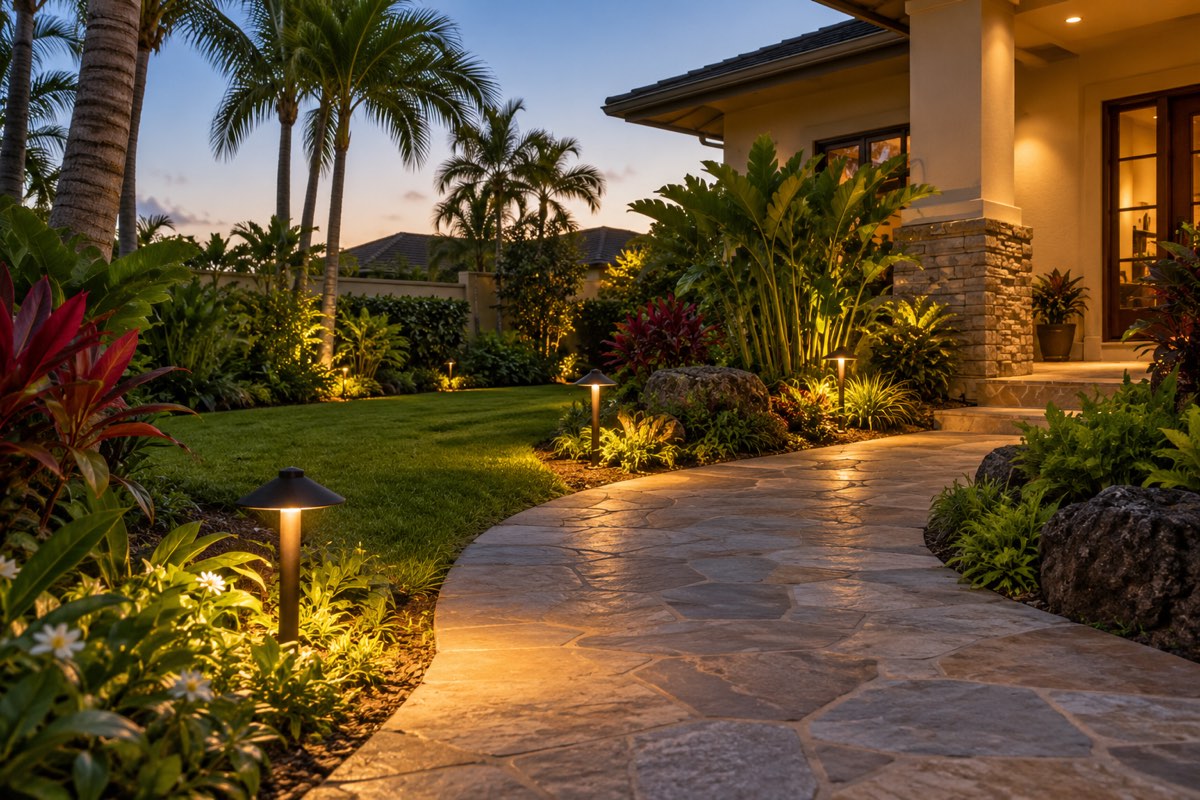
Outdoor lighting can make a residential landscape easier to navigate after sunset while bringing attention to the trees, pathways, and architectural features that define the property.
But installing landscape lighting on Oahu involves more than choosing attractive fixtures. Salt exposure, irrigation spray, cable routing, and electrical requirements all influence how a system should be planned.
For homeowners considering residential outdoor low voltage lighting on Oahu, the most important decisions involve fixture durability, lighting placement, transformer capacity, and installation scope.
At Pacific Island Landscape, we plan residential low voltage lighting around each property's existing landscape and intended use. This guide explains what to consider before installation, how to compare equipment, and what affects project pricing.
Why Low Voltage Lighting Works for Residential Landscapes
Most residential low voltage landscape lighting systems use a transformer to reduce household electrical voltage from approximately 120 volts to 12 volts.
This lower operating voltage makes the lighting system suitable for many outdoor applications when properly designed and installed. However, electrical connections, equipment ratings, and installation requirements still matter.
Low voltage systems are commonly paired with LED fixtures, which offer several practical advantages.
According to the U.S. Department of Energy, LEDs can use approximately 75% less energy than incandescent lighting and last substantially longer under appropriate operating conditions.
Energy efficiency is particularly relevant in Hawaii, where electricity prices have historically been higher than in other states, as reported by the U.S. Energy Information Administration.
For homeowners, low voltage LED lighting offers an opportunity to illuminate selected outdoor areas without relying on higher-wattage traditional fixtures.
Actual electricity consumption depends on the installed wattage and operating schedule.
Choosing the Right Lighting for Different Areas
A successful residential lighting plan starts with how the property will be used after dark.
Not every part of the yard needs the same type or amount of illumination.
| Outdoor area | Lighting approach | Main consideration |
|---|---|---|
| Garden pathways | Shielded path lights | Illuminate walking surfaces without glare |
| Entryways | Directional landscape fixtures | Define approach routes |
| Palms and specimen trees | Adjustable uplights | Highlight trunks or canopies without excessive spill |
| Steps and retaining walls | Step or under-cap lighting | Improve visibility at elevation changes |
| Planting beds | Low-output accent lights | Highlight selected foliage and landscape features |
| Lanais and seating areas | Soft indirect lighting | Maintain a comfortable nighttime atmosphere |
Pathways and Entrances
Path lighting should illuminate the walking surface rather than shine directly toward approaching guests.
Instead of installing fixtures at identical intervals without considering the surroundings, evaluate bends, steps, planting areas, and changes in walking direction.
Shielded fixtures and appropriate spacing can help reduce distracting glare.
Trees and Landscape Features
Uplighting can emphasize the structure of a mature palm, specimen tree, or architectural planting feature.
However, fixture placement should account for future plant growth. Nearby shrubs may eventually obstruct a beam, while fixtures positioned too close to trunks may interfere with landscape maintenance.
Our residential landscape maintenance services can be coordinated with lighting considerations when the work is included in the approved scope.
Lanais, Steps, and Hardscape
Soft lighting near outdoor seating areas can make evening use more comfortable without overpowering the landscape.
Step lighting and under-cap fixtures can improve visibility around elevation changes. Fixtures should be positioned to illuminate the intended area without directing unnecessary light toward neighboring properties or bedroom windows.
Selecting Fixtures for Oahu's Coastal Conditions
Salt air is an important consideration for outdoor lighting, particularly on properties exposed to coastal winds and ocean spray.
Moisture and salt deposits can accelerate corrosion in unsuitable metal housings, fasteners, and electrical connections.
The right material depends on the property's exposure and the manufacturer's specifications.
Comparing Outdoor Lighting Materials
| Fixture material | Potential advantages | Considerations |
|---|---|---|
| Solid brass | Corrosion-resistant and develops a natural patina | Higher initial material cost |
| Copper | Resists many forms of atmospheric corrosion | Surface appearance changes with exposure |
| Marine-grade stainless steel | Suitable for certain demanding environments | Grade, fabrication, and installation details matter |
| Coated aluminum | Lightweight and available in many finishes | Damaged coatings can expose metal to corrosion |
| Composite or plastic | Not subject to metal corrosion | UV resistance and long-term durability vary |
Material alone does not determine how long a fixture will perform. Seals, drainage, connection quality, and manufacturer ratings are also important.
When comparing outdoor lighting products, homeowners should ask:
- Is the fixture rated for its intended outdoor exposure?
- What do the manufacturer's warranty terms actually cover?
- Can the LED lamp or module be replaced?
- Are replacement parts available?
- How are cable connections protected from moisture?
We review property exposure before confirming equipment in a residential lighting proposal.
A sheltered inland landscape may have different requirements from a coastal property experiencing regular salt spray.
Transformers, Wiring, and Voltage Drop
An attractive lighting design can still perform poorly if its electrical components are not properly matched.
Three elements deserve attention: transformer capacity, cable selection, and connection quality.
Transformer Capacity
The transformer supplies low voltage power to the landscape fixtures.
Its required capacity depends on the combined connected load and the manufacturer's operating requirements.
A commonly used planning guideline is to keep the connected fixture wattage around 80% or less of the transformer's rated capacity. However, the selected manufacturer's specifications must govern the final design.
Larger or multi-zone systems may require additional planning for load distribution and controls.
Cable Size and Voltage Drop
Voltage drop occurs when electrical resistance reduces the voltage delivered along a cable run.
Longer distances and higher electrical loads can make the effect more significant.
Residential landscape lighting commonly uses cable sizes such as 12- or 14-gauge, while some longer or heavier-load applications may call for larger conductors.
The correct size depends on the actual system.
Some LED fixtures can operate across a range of input voltages. Others have narrower requirements.
We therefore review cable routing, known equipment information, and fixture compatibility rather than assuming a particular transformer or cable will work everywhere.
Connections and Cable Routing
Poorly protected connections can become a source of lighting failures, especially where moisture is present.
Cable routes also need to account for irrigation lines, plant roots, planting beds, and existing hardscape.
Burial depths and connection methods must follow applicable electrical requirements and the selected equipment's installation instructions.
These details are easier to address before new planting or hardscape work is completed.
DIY Installation vs. Professional Landscape Lighting
Some low voltage lighting kits are intended for homeowner installation, particularly when they connect to an appropriate existing power source.
However, the low voltage side of a system should not be confused with work involving household electrical circuits.
Installing a new outlet, modifying a line-voltage circuit, or performing electrical panel work requires separate consideration by appropriately licensed electrical professionals.
Applicable permit and electrical requirements should be confirmed with the Honolulu Department of Planning and Permitting.
Professional planning is especially useful when a project involves substantial cable routing, irrigation coordination, existing hardscape, or multiple lighting zones.
Our residential lighting work focuses on the approved low voltage landscape system. Line-voltage and panel work are outside our service scope and must be assigned appropriately.
For homeowners planning broader outdoor improvements, we can also coordinate lighting considerations with residential landscape installation when included in the project scope.
What Affects Residential Landscape Lighting Costs on Oahu?
There is no single reliable installation price for every residential landscape lighting project.
The final cost depends on the property, selected equipment, and work required.
Five factors commonly influence a proposal:
- Number and type of fixtures. More fixtures increase equipment requirements and installation work.
- Materials and exposure ratings. Fixture construction and suitability for coastal conditions affect product selection and price.
- Transformer and wiring requirements. System capacity, cable length, and distribution influence material needs.
- Installation conditions. Existing irrigation, rocky ground, hardscape crossings, and limited access can add complexity.
- Electrical work outside the low voltage system. A new power source may require a separately scoped electrical contractor.
Homeowners can manage project scope by prioritizing the areas that matter most.
For example, an initial installation might focus on entry pathways and steps. Accent lighting around specimen trees or additional garden areas could be considered separately.
Before approving a quote, confirm whether it includes the transformer, fixtures, cable installation, connection materials, and any agreed landscape restoration.
At Pacific Island Landscape, pricing follows a property review and a written scope of work. This makes it easier to identify what is included and which responsibilities are excluded.
How to Evaluate a Landscape Lighting Installer
The right installer should be able to explain how the proposed system responds to your property rather than simply recommending a fixture package.
Before proceeding, ask:
- How will you account for coastal exposure and irrigation spray?
- What fixture materials and equipment are being proposed?
- How will transformer capacity and cable routing be evaluated?
- Who handles any required line-voltage electrical work?
- Are hardscape restoration and landscape cleanup included?
- What maintenance responsibilities and manufacturer warranties apply?
Be cautious about proposals that promise a particular fixture lifespan without considering site exposure or that describe landscape lighting as a complete security solution.
Lighting can improve visibility in selected areas, but it cannot prevent unauthorized access.
Planning Your Residential Lighting Project With Us
We approach residential low voltage lighting as part of the property's overall landscape.
Our process begins with understanding which areas you want illuminated and what you want the lighting to accomplish.
We then review visible site conditions, proposed fixture locations, cable routing considerations, and equipment requirements.
For larger residential landscape design projects, lighting can be considered alongside planting plans and other exterior improvements.
Once the scope is agreed upon, equipment, installation responsibilities, exclusions, and scheduling are confirmed through the project process.
Our goal is to provide a clear plan that reflects the property's conditions and your intended use.
Request a Residential Landscape Lighting Quote
A thoughtfully planned low voltage lighting system begins with identifying where illumination will be useful and which equipment is appropriate for the location.
Whether you are adding lighting to an established estate landscape or incorporating fixtures into a new installation, we can review your project requirements.
Request a residential landscape lighting quote or call 808-347-4462 to discuss your property.
Pacific Island Landscape | Kapolei, Oahu | Contractor License CT-35972