Your landscape may have looked excellent when it was installed, but ongoing care is what determines how it develops. When hedges become uneven, irrigation problems go unaddressed, or maintenance visits no longer meet your property's needs, it may be time to reconsider your landscaping provider.
Switching landscape maintenance companies on Oahu involves more than finding another crew. An established residential landscape has existing plantings, irrigation systems, and maintenance requirements that a new contractor needs to understand before taking responsibility.
At Pacific Island Landscape, we provide residential landscape maintenance for luxury homes and private estates across Oahu. We can also take over landscapes installed or previously maintained by another company, beginning with a site audit and a property-specific scope of work.
Here's what homeowners and estate managers should review before making the change.
When Should You Consider Changing Landscape Maintenance Providers?
Changing contractors does not necessarily mean your landscape needs to be redesigned. Sometimes, the main concern is that the existing maintenance arrangement no longer matches the property.
Common reasons to review your current provider include:
- Inconsistent plant care: Privacy hedges lose their intended shape, or pruning practices are unsuitable for established specimens.
- Recurring irrigation concerns: Certain planting areas remain excessively wet while others receive insufficient coverage.
- Unclear service responsibilities: You are unsure whether irrigation checks, tree care, or debris removal are included.
- Communication problems: Requests are difficult to track, and you do not have a clear point of contact.
- Changing property requirements: Mature trees, newly installed planting areas, or upgraded hardscapes require a different maintenance approach.
Before switching, identify which problems relate to service performance and which may be caused by existing landscape conditions.
For example, a struggling planting bed could result from irrigation coverage, soil conditions, pest activity, or a combination of factors. A change in maintenance providers alone may not correct the underlying issue.
What Should a New Landscape Contractor Inspect Before Taking Over?
A contractor should understand the property's current condition before proposing ongoing work.
This is especially important for established Oahu estates, where mature trees, privacy screening, and irrigation infrastructure may represent significant investments.
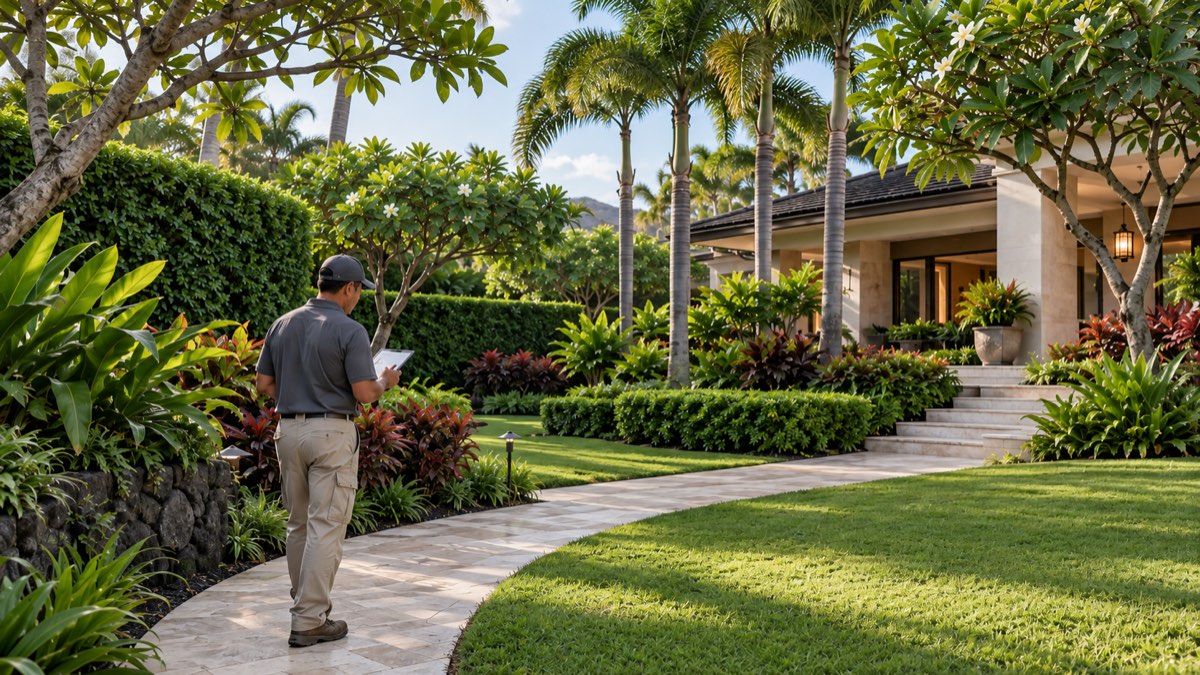
Our estate maintenance service begins with a site audit when we take responsibility for an existing landscape.
Irrigation Performance
Irrigation systems deserve particular attention during a maintenance transition.
A new contractor should review visible coverage concerns, operating schedules, and accessible system components. Problems may include leaking heads, poorly directed spray, or watering patterns that do not match planting areas.
At Pacific Island Landscape, irrigation auditing is part of our residential estate maintenance offering. Our programs include regular inspections and adjustments within the approved scope.
More extensive repairs should be identified and scoped rather than assumed to be included.
Established Trees and Privacy Hedges
Mature trees and established hedges often define the appearance of a residential estate.
Before changing pruning practices, a new provider should understand the intended shape of the plants, their current condition, and any visible concerns involving their growth.
A privacy hedge should not be cut back aggressively simply because it has become overgrown. Appropriate pruning depends on the plant and its condition.
Our maintenance services include hedge and plant care along with canopy management, with the specific responsibilities defined in the maintenance agreement.
Plant Health and Pest Concerns
Browning foliage, leaf spotting, or thinning plant growth should not automatically be treated as proof of disease.
Irrigation problems and environmental stress can produce symptoms that resemble pest or disease damage.
We offer residential landscape disease control when plant-health concerns require separate evaluation and a defined treatment scope.
For palms showing possible coconut rhinoceros beetle activity, we can also review the need for our CRB removal and treatment service.
Treatment does not guarantee that a damaged palm will recover or that beetles will be eliminated. Recommendations depend on the observed conditions and any applicable product-label requirements.
Why Oahu's Growing Conditions Matter During a Maintenance Transition
Two properties on Oahu can have very different landscape maintenance needs.
A coastal estate in Portlock may experience salt exposure that affects plant performance. A property on Hawaii Loa Ridge may encounter stronger winds and different access considerations. Protected garden areas can have their own watering and pruning requirements.
These differences matter when establishing a maintenance program.
A provider taking over an established property should review its particular exposure rather than applying the same routine to every planting area.
Our approach considers local growing conditions and the existing landscape's requirements. This helps us define maintenance responsibilities around what is actually present on the property.
For established landscapes with substantial plantings, the purpose is to support the original design intent while addressing observable maintenance needs.
What Should Be Included in a Landscape Maintenance Agreement?
A written scope of work is one of the most important documents to review before switching providers.
It should clarify what the contractor will perform, how frequently recurring services will occur, and which responsibilities are excluded.
The following table provides practical points to discuss with any prospective contractor.
| Maintenance Area | What to Clarify |
|---|---|
| Hedge and plant care | Pruning expectations, plant-specific needs, and routine care |
| Irrigation | Inspection responsibilities, adjustments, and separately quoted repairs |
| Trees and canopy | Routine pruning versus larger or specialized tree work |
| Pest and disease concerns | Routine observations versus separately approved treatments |
| Hardscape areas | Clearing of pathways, courtyards, and other defined areas |
| Green waste | Whether debris generated during visits is removed off-site |
| Communication | Who handles requests, approvals, and service changes |
Our residential maintenance programs cover hedge care, irrigation auditing, canopy management, and hardscape clearing with green waste removal.
The final agreement specifies the applicable services and responsibilities for the property.
Not every request is automatically included. For example, separately proposed landscape improvements or specialized treatments may require additional approval.
How to Switch Landscape Maintenance Companies Without Losing Important Property Information
A smooth transition begins with organized information rather than an immediate change in maintenance practices.
1. Review Your Existing Agreement
Check your current maintenance contract for termination requirements, notice periods, and ongoing obligations.
Confirm when the current provider's responsibilities end before arranging the new service.
2. Gather Existing Landscape Records
Useful information may include irrigation plans, planting lists, previous maintenance scopes, and records of major landscape improvements.
If your landscape architect prepared a planting plan, it may help the incoming contractor understand the original design intent.
These records are helpful, but a contractor should still inspect the property's actual conditions.
3. Identify Unresolved Problems
Before the property assessment, write down concerns you want the new contractor to review.
Examples include recurring irrigation leaks, declining palms, or hedges requiring a revised pruning approach.
Photographs and previous service notes can provide useful context.
4. Request a Property Walk and Written Scope
Ask the prospective contractor to inspect the landscape and explain what would be included in the new arrangement.
At Pacific Island Landscape, our process involves reviewing the property, identifying the required services, and developing a written scope with pricing and exclusions.
Scheduling follows approval of the proposed work.
5. Establish Communication Responsibilities
For larger residences, decide who will communicate with the maintenance provider.
This might be the homeowner, an estate manager, or another authorized representative.
Our estate maintenance programs provide a single senior account manager, and we can coordinate with property management or security personnel where appropriate.
Clear communication helps distinguish routine maintenance requests from work requiring separate authorization.
How Much Does It Cost to Change Landscape Maintenance Companies on Oahu?
The cost of a new maintenance arrangement depends on the property and the responsibilities included in the contract.
An established estate with mature trees, extensive hedging, and multiple irrigation zones may require a different scope from a property with relatively simple planting areas.
When reviewing proposals, consider the following:
- Property size and accessibility
- Existing plant conditions and maintenance needs
- Irrigation inspection and adjustment requirements
- Tree and canopy care responsibilities
- Service frequency
- Green waste handling
- Additional corrective work identified during the assessment
A lower maintenance quote does not necessarily cover the same work as a more comprehensive estate management agreement.
Compare the actual responsibilities rather than the total price alone.
We prepare property-specific proposals after reviewing the requested work. Pricing and any additional services are defined in the written scope.
Maintaining the Landscape After the Transition
Once a new provider takes responsibility, it is useful to establish a clear starting point.
Record any existing plant-health concerns, confirm which irrigation items require attention, and agree on the intended appearance of major landscape features.
This creates a reference for future maintenance discussions.
Some landscape problems may require additional evaluation or separately approved corrective work. Others may be addressed through routine care once the contractor understands the property.
If larger improvements are being considered, our residential landscaping services can address approved planting or installation work under a separate scope.
Our private nursery in Kapolei can also support projects requiring replacement or additional plant material, subject to confirmed inventory and project requirements.
The important distinction is that ongoing maintenance and major landscape improvements should each have clearly defined responsibilities.
Discuss Your Estate Landscape Maintenance Needs
If your current landscape maintenance arrangement no longer meets your property's requirements, we can help you review the next steps.
At Pacific Island Landscape, we work with luxury residences and private estates across Oahu, including properties in Diamond Head, Lanikai, Portlock, Aina Haina, and Hawaii Loa.
We can assess an established landscape previously maintained by another provider and define an appropriate scope for its ongoing care.
To discuss your property, request a maintenance assessment through our residential maintenance page or call 808-347-4462.
Share your property location and the main maintenance concerns you want us to review. We can then discuss the information needed for a site visit and a written proposal.
Pacific Island Landscape | Hawaii Contractor License CT-35972